Friday, 24 May 2013

Back to Chania


We left Aghios Pavlos with every intention of returning sometime; I really hope we manage it. We had a longish drive through the mountains to the other, north side of the island, as we want to see Chania, and that's where we fly home from.

We stopped in Spili, the regional centre, which is a lovely little town, with a delightful square with a very long fountain, a trough with a row of lion heads spouting water, some tempting cafes (but it was too early to eat) and some really appealing tourist shops. There’s quite a lot of stuff you actually would like to buy in Crete. Wihout any intention of actually shopping, I ended up buying a tablecloth and napkins and a couple of bathmats!


The drive was less stressful than we expected, because the traffic was quite light, and the roads, on the whole, wider than we expected. It was certainly a lot less stressful than Norway or round Genoa, the two places which for us define driving stress. The scenery is spectacular – the mountains go as high as 7,000 feet and still have patches of snow on the top, and there are some amazing rock formations. It’s pretty barren – there are some pines and, I think, myrtle, and strips of pink oleander down the mountain sides marking tiny watercourses.  Occasionally, it was barren enough to make me think of Arizona, especially since all the road signs have been shot up. We drove up and up, some of the time beside the Imbros Gorge, down which the Commonwealth troops escaped to the sea in 1941. The Royal Navy managed to get a lot of them off, but about 12, 000 were captured. There’s a museum, really just a collection of all sorts of military equipment from both sides, collected by a Cretan man who was wounded in the fighting as a ten year old. It ranges from an anti-aircraft gun to a box of Mills bombs (which I sincerely hope have been made safe) and a kukri. I didn’t know Gurkha soldiers were involved.

We had a late and solid lunch at a taverna near the end of the Imbros Gorge. It was charmingly decorated, all Cretan blues and white, and run by a couple who weren’t quite old enough to be our parents. It promised home cooking, and I must say, years of experience on the part of our hostess told, and it was a wonderful meal.

We stayed just outside Chania proper, a bit back from the beach but with a sea view, and today we went into Chania, which is a delightful town. It didn’t get so badly bombed as Iraklio, so lots of the old town has survived and is mostly pedestrianized. I imagine it’s a bit grim in high season, but today there were  just enough tourists to give it a nice buzz.
Old shop in Chania
Restored house in the old Turkish quarter


The harbour is really worth seeing, with massive Venetian fortifications and a lighthouse, and enormous stone sheds, for maintaining the galleys. Apparently there were something like seventeen of them but only about eight are left.                                             
Old mosque, with harbour walls on the left
The Lighthouse
There’s also an enormous customs house, and we ate lunch in what had been an olive oil soap factory under the Venetians. Crete does make one muse on the mutability of things; the Minoans, rich, skilled, artistic and sophisticated, and gone like ash in the wind; the Venetians, the great power of the Mediterranean, and now a sinking city existing on tourism.
The galley sheds


There’s an archaeological museum, with some Minoan bits, and the best thing was a whole case of pottery bulls, left as offerings at a shrine to Poseidon, in his capacity as the god who causes earthquakes. There were offerings of real sheep and goats, but presumably a real bull was too expensive, so pottery ones were substituted.  The other good museum was of Byzantine bits, with some frescoes, mosaics and carvings. Crete has an awful lot of history.
Restaurants lining the harbour


There’s a couple of leftover minarets, and a mosque on the harbour, used for exhibitions. The one today was on the Battle of Crete. There were some amazing photographs, but one board really stunned us. It was clearly the prints of a roll of film which some German had taken at the massacre of about 35 Cretan villagers, documenting the whole thing, from rounding up the villagers, separating the men and boys, to good clear pictures of the firing squad, to the corpses. I know that psychopathic serial killers sometimes take photos, but these were ordinary soldiers. I presume they were so sure that they’d win the war that they didn’t consider the possibility of being brought to justice, but how is it that they were so lacking in shame that they would document their actions?

On a similar topic, we found a sixteenth century synagogue, with library and a mikvah. It has recently been restored because it was burned in 2010, by, according to the information, two British, two Americans, and one Cretan. How depressing is that? Especially since the synagogue had a plaque in memory of the Jews of Chania,  who were deported and killed towards the end of June 1944. After D Day, when surely, surely the Germans knew they were going to lose the war.
Church with bell tower and ex-minaret


To return to more cheerful topics – I’ve bought olive oil, herbs, and saffron, and even a bottle of raki. We keep being given a free tot after meals and it’s the nearest thing to lighter fuel I’ve ever tasted. But we had a taste of some with lemon and honey (and it was weaker, thank God) and it was nice. So I’ve also got a small bottle flavoured with pomegranate.

Then we went back to the hotel and I changed to go down to the beach for a swim. It’s quite windy today, so it was mostly jumping the waves and not a lot of actual swimming, but very invigorating.

The journey back was much less stressful than the journey out; and the whole week was a terrific success. Every cafĂ© had a group of old boys sitting drinking and gossiping, and definitely not helping with the housework, shopping or cooking,  with the result that  Phil wants to retire to Crete.

Tuesday, 21 May 2013

Aghios Pavlos


The hotel is really good – there are people staying here who are on a yoga course, and the atmosphere is mostly Mediterranean, but crossed with a bit of new age-y incense and posters of Buddha. The situation is fabulous and the owners are not charging any more than normal for the food, which is quite impressive, since there aren’t really any other convenient places to eat, and they have a pretty captive clientele. The food is good, too.The only complaint I’ve got is that the shower cubicle is tiny, so we’re just using the bathroom as a wet room, and as it’s so hot, it dries off in no time.

                         Aghios Pavlos Hotel

It’s good place for people watching as well as swimming. A German bloke was showing two nubile ladies a couple of stones – they looked pretty average for round here but he kept them talking for ages and they seemed genuinely interested. Phil was puzzling over that for ages. Then there was the English couple, younger than us but certainly well into their forties, where the woman was teaching the man “Scissors, paper, stone.” This raised a number of questions. Who doesn’t know how to play it?  How long have they been a couple – not long surely, if they don’t know things like that about each other; but how long are they likely to last if she’s reduced to teaching him how to play it, on holiday in a place like this?  Also, a large proportion of the guests are German, who are completely fazed by the British convention of saying hello to anyone you meet walking outside of a town.
   
                                       Looking out from the hotel

The sea is a bit dead, after the Red Sea, but there are a few different sorts of small fish, and sea urchins, and I got very mildly nettled by a jelly fish. I would love to see an octopus, but no luck. I think they’re quite shy. It doesn’t matter. I love sea swimming.

We are so pleased with this place that we’ve asked to stay an extra night. I reminds us of the Amalfi coast, but as it was forty four years ago. Only it’s a lot less lush. 

Monday, 20 May 2013

Sunday - to the seaside


We got up to cloudy sky and poor visibility, but still warm, so no complaints, and we drove off to Gortyna and Phaistos, which is another Minoan site. We needed cash (everyone wants cash and tells us they can’t take credit cards, I suppose because it’s easier to dodge tax.)  There seems rather a dearth of ATMs , compared with England at any rate, and when we eventually spotted one it wasn’t working. So it was a relief to spot one in a scruffy little town in the mountains, and even more of a relief when it worked. There was also a general store and we needed water, fruit and, ideally, some sticking plasters , as I’ve got a slightly sore patch on my foot. But the only box of plasters was opened. To our amusement, the lady behind the counter made it clear that sticking plasters are sold by the piece not the packet. So we bought four plasters and some local honey, as it seemed that we would be being positively rude if we left without any.

By the time we got to Gortyna it was really getting hot and the clouds had disappeared.  So we slapped on the suncream and saw what there is to see. It was the capital of Roman Crete and obviously covered a very large area, a lot of which is not excavated as it’s under ancient olive groves and a village.
                            A bit of Gortyna, in an olive tree.

What you can see is the odeon, which was pretty complete, though not as complete as the one in Amman. But on the back wall, there is inscribed the code of law. It’s massive, and deals with marriage and inheritance as well as crime. As far as I could make out the punishments seemed to be fines. What happened if you couldn’t pay the fine wasn’t specified, but it must have happened. For example, rape of a slave, male or female, cost you 5 whatever the coinage was. But rape of a free person cost you 100. However, if a slave raped a free person, it cost the slave 200. So then I spent the rest of the day wondering if a slave could conceivably have paid up, and if not, what they did to him.

                    The odeon - the laws are under the brick arches at the rear.

The other main site was a very early Christian basilica, about 250 A.D. founded by Titus, Paul’s disciple, as in the epistles. I got quite excited about that. It wasn’t quite as good as walking along “the street called Straight” in Damascus, but pretty good. A bit along the road was a small chapel over the tombs of ten Christian martyrs, from 250 A.D. That was quite exciting too. 

The graves of the ten martyrs.


Phaistos was  only understandable if one had been to Knossos and the museum. But as we had, it was very interesting. It’s very similar to Knossos. They both make me think of Gormenghast; massive efforts put into rituals rather than life itself, and all sorts of people under the same roof, although in Gormenghast  the craftsmen lived outside – here, even they, with their mess and furnaces, are inside the complex.  It is a labyrinth, too, with scores of tiny rooms.
Phaestos North Courtyard with processional way.


By this time it was really hot – I really wouldn’t like to visit in summer – and we still had to visit the third Minoan site, Agia Triada, which is down a hill, so quite a lot of stairs to return to the car. We’ve got the hang of Minoan sites now, but they are still strange. This one had much more obvious water supply and drainage arrangements than Phaistos.
Then to Vori, where there is a really interesting small museum of Cretan everyday life. There were some wonderful photos, including photos of the partisans and S.A.S. men who kidnapped the German commander. Fifty Cretans, who had nothing to do with the kidnap, were shot as a result. There was every sort of everyday living and craft working implement, all very well displayed. It was much better than I’m making it sound. We had a very late lunch, Cretan salad which is Greek salad with extra bits like egg and capers, which really hit the spot.
We drove on over the mountains which are spectacular, but sadly we’ve missed the wild flowers we hoped to see. We must be just a bit too late. All there is, is some broom nearly finished, and lots of oleander.
Finally we arrived at our destination, Aghia Pavlos, and it’s a triumph, a beautiful cove, very quiet as the road ends here, and a lovely hotel/taverna. I’ve already had a super swim, and now we’re off to eat.


Saturday, 18 May 2013

Crete


We had a week off grandparent duties (or as it’s otherwise known, fun) and decided to go away, perhaps to Suffolk or Dorset. But the weather has been so cold and miserable, Phil decided to see where we could get to from East Midlands for a week. One of the places was Crete, so here we are, sitting outside in the evening while I write this, with the sea to look at if I need inspiration.

I must say, though, we suffered for this. East Midlands may be the closest airport, but it must also be the least efficient in Britain. And cheeky - £3 a head for express through security, which wasn’t express at all, because the queues were so long (right out of the terminal)  that loads of people were gritting their teeth and paying up. To cap it all, of four ticket machines, only two were working and they seemed to be on a go slow. The security was alarming, too – the arch beeped at everyone, even small children, so what was the point of it? Then they kept sending things back to go through the XRay again (my shoes and my E reader, but not Phil’s E reader, got the treatment), and as they weren’t wearing gloves and things kept going back and forth, not with their original bags, there must have been a high chance of contamination, had there actually been anything to detect. It all took ages, and it was really stressful, trying to keep track of one’s belongings.  Then Chania must be low down the efficiency rankings even for Greece. East Midlands and Chania were so lousy that we felt full of the milk of human kindness towards Ryanair, so that shows you.

We picked up the hire car and set off for Iraklion. We stopped for a potter round Rethymno, which was pleasant, and has a very extensive fort, built by the Venetians originally. The Ottomans converted the church to a mosque, and there were other ex-mosques, including one or two minarets. It was beautifully warm after England, but very, very windy; occasionally it actually blew one off balance, so definitely not a day for the beach.

The hotel is just outside Iraklion proper, and perfectly fine. So we walked up the road for a meal, very decent, which was lucky because we were absolutely starving.

Today we left straight after breakfast for the centre of Iraklion, and managed after not too fraught a drive, to park near the Archeological Museum. This has been under renovation during the whole of living memory, but there is one small gallery of sculpture and one gallery of the Minoan best bits which are open, and in fact were free, as today is World Museum Day or some such.

I might as well confess, I didn’t manage to choose one object. It was alright in the sculpture gallery – there was a temple frieze of horsemen from the sixth century B.C., very stylised and austere, with the riders much smaller in proportion than the horses, and I’m having that. It’s great. But then the Minoan stuff – well, I just can’t choose. The very early, prepalatial, stuff reminded me of the early things we saw in Syria, although that was even earlier. But then, it was as though the Minoans found their own view of the world, quite different to anything else I’ve seen. The jewellery! You could wear it today, too, it’s not outlandish or over exotic, just beautifully made with exquisite craftsmanship and taste. The pottery was stunning; normally it leaves me rather cold, but this was so lovely that for a moment I considered buying a replica! There was a jar or vase with an octopus painted on it, and a jug with a leaf design that made me think of William Morris. Then there were the bronze swords and knives with gold fittings, the frescos, the vases and jugs in alabaster and such, the famous bull’s head libation cup, with the most amazing and beautiful detail – I could go on and on. So I can’t, I really can’t, choose one thing. Phil chose the Bee pendant, which was utterly exquisite.

So then we had a look at the fortifications, which are Venetian and massive, very impressive, then retrieved the car and went to Knossos.
The Throne Room (as Evans thought.)

I’m glad we did the museum first, and although I’m aware that Arthur Evan’s reconstructions are controversial, to say the least, I was actually quite glad of them, because without the reconstructions, and without having seen the artefacts in the museum, I’m not sure how much the site would have meant to me. I think Crete must have been more fertile then, because looking at the hills around the site, it’s difficult to imagine how they got so rich. But North Africa used to be Rome’s breadbasket. And Crete is certainly in a good position for sea trading. However, it quite often seemed as though Evans had an over active imagination.  I must see if there’s a readable up to date account. Of course, like everyone else of my age,  I read Evans’ The Bull of Minos years ago, but ideas have changes since then, though they still haven’t deciphered Linear A.
Another of Evans' reconstructed bits, but I forgive him.

One of the nice things, was the enormous storage jars. Yo could quite see how king whatever his name was could hide in one when Heracles turned up with the man eating boar. Sorry for the vagueness of my classical mythology - it's age I'm afraid. But I do remember the jar bit, and being slightly puzzled by the idea as a child. 

Then we had a late and very substantial lunch, and went back to the hotel, for a swim and a sit. This is the life. 

Saturday, 20 April 2013

A grand Day Out


The village of  Laxton in Nottingham is unique in England, because it retains a lot of the pre-enclosure, medieval open field system.  Our day out there was completely fascinating, and the best thing I’ve done for ages. It didn't start that well, because I had offered to drive a car load and was so pleased with myself for being early, that I drove off without one of my passengers. I don't know when I might have realised - perhaps not until we got to Laxton, who knows - but luckily another passenger noticed someone missing before we'd got too far. All a bit shaming. 
One of the fields - you can see the strips

Looking across to another of the open fields.

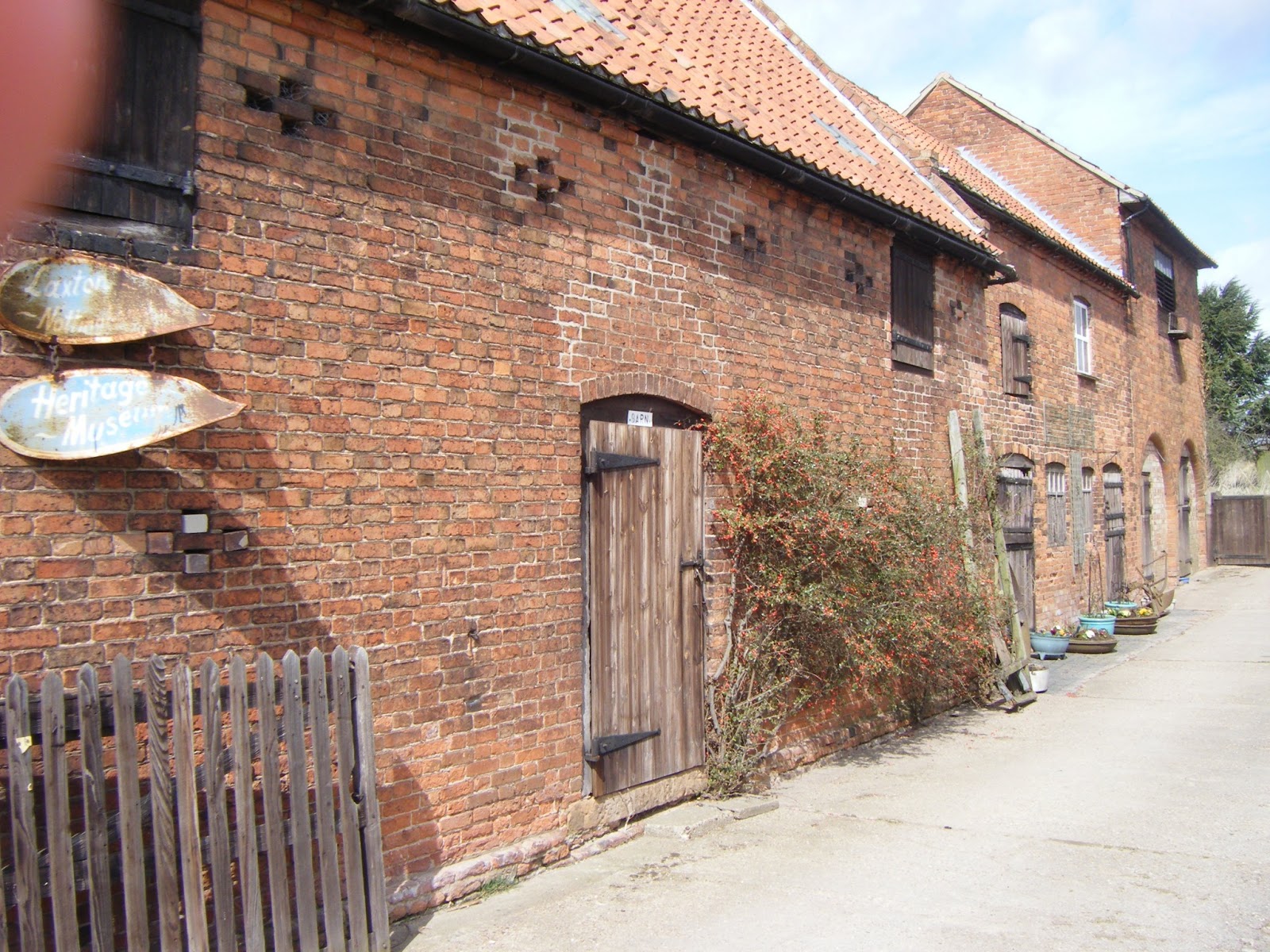
The farms are all along the main street of the village, all with the buildings that they once needed to operate. Each has its own threshing barn, which of course isn’t required nowadays. The system may be medieval, but the farmers are able to adopt modern methods, which was a relief to us visitors, because having seen a threshing flail, none of us could imagine the strength and stamina required to thresh a crop of wheat in that way.

A typical range of farm buildings

A  threshing barn. The door height is to allow the wind to blow through.

Each farmer has strips of land in each of the three enormous unenclosed fields. The idea is that good and poor land is shared out evenly, but of course it means that it isn’t really an economic way of farming nowadays, even though the strips have been amalgamated, and are a lot wider than they were in the seventeenth century.


 At the end of the seventeenth century the landlord had the most amazing and fascinating map of the village and its lands drawn. It isn't simply a map - there are all sorts of delightful tiny scenes depicted - haymaking, hawking, horses romping around in the field - it's really more like an aerial view of the estate, with all its activities. It’s now in the Bodleian, but there is a copy in the church.  The church in itself was more than worth a visit, and there is an excellent motte and bailey, and super views.

Because the open fields have survived, so has the manorial court, with its system of stewards and bailiffs, field foremen and jurors, who all cooperate in maintaining the way of life – because it is much more than a farming system; the way the land is used means that there are all sorts of cultural practices which go along with the with it. I think it should be a World Heritage Site, as it certainly falls into UNESCO’s category of a “Cultural Landscape”;  but I think UNESCO aren’t really interested  in European / developed nation sites now. They are trying to register sites in much less developed and visited nations, which is probably the right thing to do. However,  Laxton could certainly do with support in maintaining the land use system and cultural practices which date from the Domesday  Book.

We were all hugely impressed by our guide’s knowledge and commitment to the system – and although we  didn’t meet others of the farmers, it’s clear that they all must feel similarly, because it’s hardly a convenient system nowadays, and it isn’t possible to make a living from farming alone – everyone must have other strings to their bow. So apart from farming, our guide, Stuart, has horses at livery and does some blacksmithing.  

There are grants to be had from Natural England, as the fallow field has been used to encourage ground nesting birds, and the “sykes” (pronounced “sicks”) have never ever been ploughed, so attract grants as ancient meadowland.
The green lane between the church and the motte and bailey.
 But the rules are changing, to bring them into line with the whole E.C., and the Laxton farmers will lose a lot of income. Why the rules can’t be bent, considering what a special case this is, goodness only knows. You’d hardly think giving them some special consideration would destroy the whole European plan – after all, as I said, it’s unique in England. Maybe in Europe.

This is the link to Stuart’s site.

Just to make the day out perfect, Stuart’s mum and sister provided copious amounts of delicious food. I don’t wish to mention any names, but some people had all three puddings, and then in the afternoon, scones and both sorts of cake.  I have to give the rhubarb, orange and ginger crumble a special mention as the best I have ever tasted.  I can’t urge you too strongly to visit – it really is a grand day out. 

Wednesday, 17 April 2013

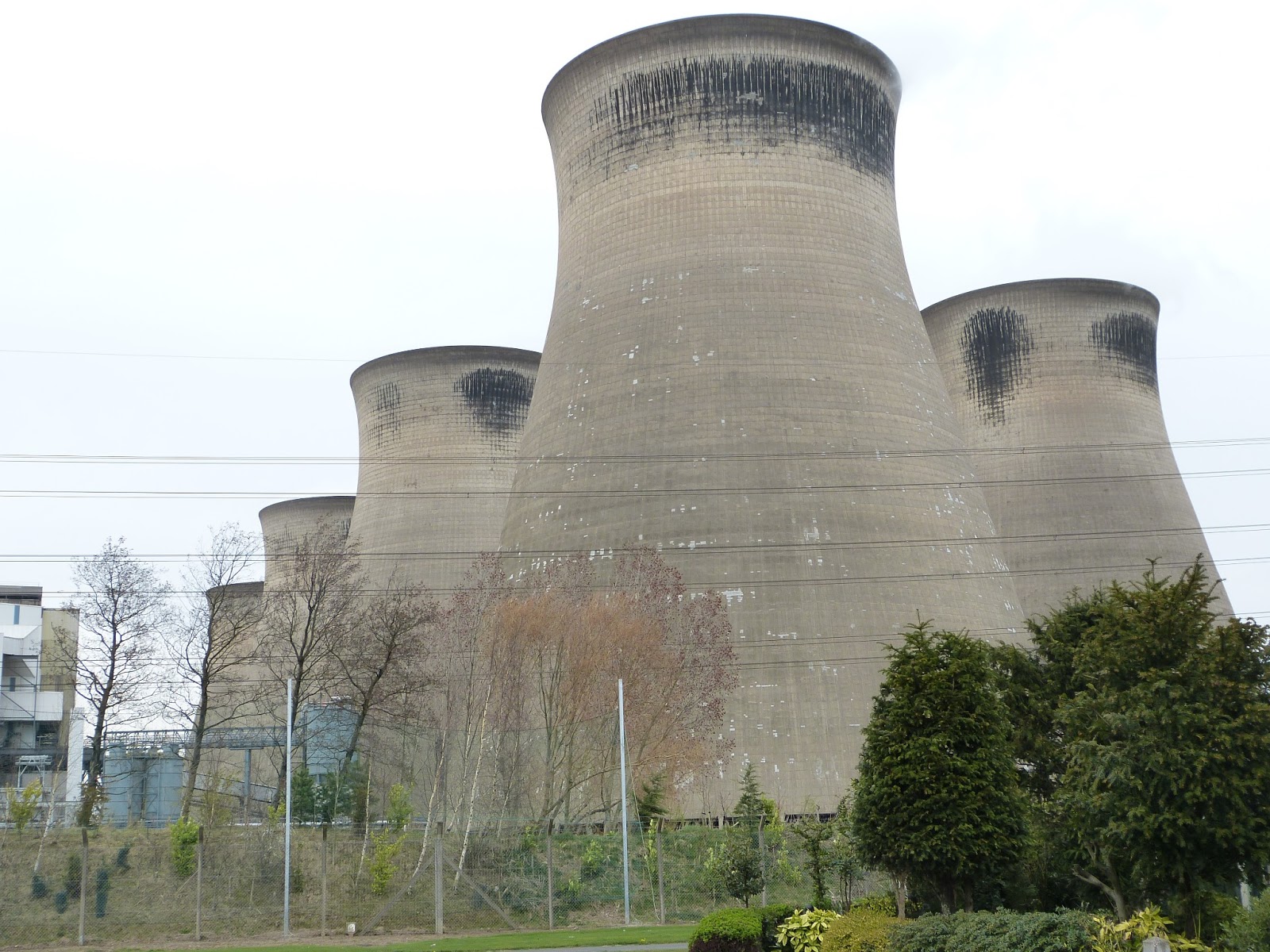
Ferrybridge Power Station C


A dedicated reader of this blog (always supposing I have any such) may remember that I planned to take a photo of Ferrybridge Power Station, because in my mind, it’s a kind of “welcome home” sight – once you’ve passed Ferrybridge, you’re in the North. I’m not sure what Sheffield inhabitants would make of this, because it they’re south of it. Also, I’m perfectly aware that any feeling of homecoming is ridiculous, since I stopped living in the north (as defined by Ferrybridge) when I was eighteen. More than two thirds of my life so far has not been lived in the north, so why it still figures as “home” in my mind, goodness only knows. But there you are. Nothing logical about it.

Also, Ferrybridge is pretty impressive. But every time we’ve been up or down to the north east since a made the undertaking to take a photo, the weather has been appalling. Rain, snow, and fog, once so thick that we couldn’t see any vestige of the cooling towers. Frankly, that day, it was just stupid of us to be travelling at all.

So today, we were making our monthly trip to the north east and it wasn’t actually raining or snowing. You couldn’t call it a nice day, but I’m getting desperate. So with much help from Phil’s map reading skills, we turned off the A1 and got some photos. Here you are:

From the Aire and Calder Navigation


As a bonus, here is the original Ferrybridge, dating from 1797, and the toll house. I think I remember driving across the original bridge when it was notorious for traffic jams. That went on for years and years. Now one swoops through, hardly noticing the river. You can't really miss the power station, though.


Sunday, 14 April 2013

Legacies


There’s been two items of news that have really got me cross recently. One was the Pope’s resignation, or abdication, or whatever you should call it, and then the election of the new Pope.  Luckily, the election was pretty quick, because I was losing all patience with having the white smoke / black smoke palaver explained to me, as though I was stupid. Mind you, Chuka Umunna doesn’t seem to have listened. He thought the black smoke thing was some sort of racist comment, God help us. It’s hard, as you get older, not to get cross with having obvious stuff explained in words of one syllable, and I have to try to remember that once, I needed it explaining. Mind you, I should think I was about ten, not thirty five years old.

The other thing that annoyed me about the election was that it seems utterly irrelevant. Catholics, in England anyway, just seem to ignore the Pope’s teaching on contraception etc. Quite right too, but it does make the whole shebang pointless if members of the church ignore their leader’s pronouncements.  And another thing that makes the whole thing pointless is the way the church has dealt with the numerous child abuse scandals. 

Someone I know tried to defend the Catholic Church, on the grounds that all organisations close ranks and cover up when there is a scandal. But what on earth is the point of the Catholic Church, if it can’t deal with a sex abuse scandal better than, say, British Airways, could?

Also, I must admit to being prejudiced. When I visited the Vatican Museums, the thing that went through my mind over and over, was "I'm sure this isn't what Jesus had in mind!"

Then I’ve got really cross with the press coverage of the Thatcher’s death celebrations. If you notice, all those out on the street “celebrating” are far too young to know anything about it. You had to live through the years before Thatcher to have any idea why she did as she did, and why she is still a heroine to many people.

I remember the three day weeks, the endless power cuts, the bread shortage, the toilet paper shortage, the incredibly poor quality of practically anything manufactured in Britain. There was a “joke”, which was that if you had a reasonably reliable car, it must have been manufactured on a Wednesday. On Mondays, the joke went, workers were overhung and couldn’t be bothered, and on Friday all they cared about was leaving work early, so only cars made on a Wednesday had any chance of being O.K.

I remember the British Steel workers clocking on and then clearing off home for a sleep. They threatened to strike when management tried to get them to wear safety gear. Years after they all lost their jobs, I met a chap who used to work in the steel plant. It turned out that he had been out of work for years. When I said I was sorry, he answered “Oh, don’t be. We asked for it.” 

If you don’t believe me, watch old TV – Not the Nine O’ Clock News, and the dead printer, fastened to the radiator so he still couldn’t be sacked. Or even The Good Life, where the gardener refuses to read a note because he’s a manual worker. They’re exaggerated, of course, but they were only funny because the situation was recognisable.

I worked for the Inner London Education Authority briefly, and I impressed it upon my husband that no child of ours could possibly attend any of its schools. That’s why we moved out of London, and why I can’t really respect Ken Livingston, although I do think he did well as Mayor of London, eventually.

Now none of this is to say that I support Thatcher’s policies in general. For example, I really wish she’d put the money from the North Sea and the sell offs into more modern infrastructure, and I wish she’d thought of planning ahead and improving education. There are practically no jobs for the thick but strong that allow you to support a family, in the way that labouring in the ship yards or mines did, so a better educated work force is vital. But don’t blame Thatcher for the decline of manufacturing. That’s globalisation, and the fact that most of what we had was rubbish. 

It’s much too early to come to any balanced conclusion about Mrs Thatcher’s premiership, or her legacy. But we should try to keep a more open mind than so many commentators.