Tuesday, 25 March 2014

Florence


Having had two highly successful out of season visit to tourist hotspots – we went to Venice in January and Rome in February – we’ve decided to visit Florence. I went to Florence in 1969. A friend from university and I flew to Milan and got the train back from Naples seven weeks later. We spent about five days in Florence. Phil went to Florence fifty years ago, on holiday with his parents.

We drove down to Stansted yesterday, as the flight to Pisa was early. All went well, although the airport was rammed – I can only suppose it’s normal on a Monday morning. Then we got the bus from Pisa airport to Florence. The hotel is in an old palazzo and about two minutes’ walk from the Duomo, and it’s got painted ceilings and stained glass and old bits of painted furniture, so we’re pleased.

We went straight off to the Duomo. We were seriously daunted by the crowds waiting to go in, and especially the queue for the ascent of the dome. Maybe March is too late to avoid the crowds. There are lots and lots of student groups, so perhaps it’s school trip time. They hang round in big, milling crowds, and it’s difficult to tell whether they are just hanging about, or queuing for something. 

Anyway, we went into the Duomo – but most of it is roped off, it’s sad. I suppose it doesn’t matter that much as there is not much specific to see inside the church, it’s the size and proportions that matter. But I would have liked to get a closer look at Uccello’s wall painting of Sir John Hawkwood. In 1969 I was surprised to see an English knight given pride of place in the cathedral, but I didn’t know anything much about him – really, I only knew he was a condottiero, and what condotierri were. But since then, I’ve read a biography, and he had a fascinating life.  It’s also quite funny – Florence paid him a pension, but that didn’t stop him attacking the city, because  someone else paid him more.

So then we plodded up the campanile – we can’t seem to resist a bell tower – and I say plodded, because it is pretty high, and because there are no handrails, so it’s really hard on the knees. My “good” knee – the one in its natural state –  felt fiery hot and pretty painful, so I have taken some ibruprofen and hope it settles down.
Christ Pancrator in the Baptistery


We went into the Baptistery – I don’t think it was open in 1969,  because I’d definitely have remembered it. The mosaics are wonderful. We loved them, and spent ages studying them. The “Gates of Paradise”, by Ghiberti, are now in the museum, and I regard that as a great improvement; I remember, in 1969, being quite excited to see them, having read all about their wonders, and being deeply disappointed.  But now, cleaned and restored, they deserve their name. There’s also very informative explanations of what biblical story is where on the panels, so you can identify the walls of Jericho and the Queen of Sheba and such like, and an interesting video on the restoration. We spent ages looking at those, too.

The "Gates of Paradise" - all clean and brilliant.


The Michaelangelo Pieta is also in the museum now. It used to be in the church, and I can’t quite see why it isn’t still there. I think it’s much more moving than the Pieta in St Peter’s even if it isn’t finished. 

On Tuesday we got up early and after a good breakfast in a wonderful dining room with a painted ceiling, went straight to the Duomo. The queue for the tour of the Dome was nonexistent, and we were able to walk in immediately. The lantern on the top of the dome is actually higher than the campanile, but some of the stairs had hand rails and also we had a long pause at the first gallery to look at the ceiling paintings, so it didn't seem nearly as tiring as the campanile.

The paintings follow a similar plan to the mosaics in the baptistery, so the lowest level is the final judgement. It’s fascinatingly gruesome. There are devils, some in animal form, others with tails, fearsome skull like features and long claws for fingernails, eating people, flaying them, buggering them with flaming spears, tossing them with pitchforks  - I could go on, but I can’t possibly do justice to the horribleness of it.
Devils, from the Baptistery. We couldn't photograph the ceiling of the dome, as there's a screen.

 There’s also Time, with his hourglass, Cerberus and the Hydra (not sure how they got in on the act), and a cheerful, skeletal death, with a sword not a scythe. Further up there’s a small depiction of the faithful going into paradise, but that concept obviously didn’t arouse the same fevered creativity as the idea of Hell.

As you go up there’s Mary, and Jesus in glory, lots of saints and popes;  maybe saints who were popes, who knows. But it’s the Last Judgement that’s so terrific. The way up the Dome and round the two galleries is pretty narrow, so it’s difficult to pass anyone, but there are short bits where you can stand and stare. We stared for ages. I’m afraid we wouldn’t have looked for half so long if the paintings had been all of saints and angels. It’s really quite hard to comprehend what effect visions like these had on the ordinary Christian. We know what effect they had on fanatics, unfortunately.

There are a lot of stairs up to the lantern, but we made it easily, and the views are superb, well worth the effort, even without getting close up to the dome paintings.
The campanile, from the lantern of the dome.


When we got down we had a long sit and an iced tea, and then I did some shopping. It’s funny, in France I’m never remotely tempted by anything in clothes shops, but I knew I’d be tempted in Italy, and so it proved. So I have two knitted cotton tops, a pair of two tone brogues, and a red satchel. I’ve been fancying a satchel for ages for city sightseeing.


A view from the lantern of the dome.

Then we went to the city market, and had lunch of crispy fried squid and pieces of cod, with a helping of chips, sitting along the front of a fish stall while one of the owners did the cooking and the other prepared squid and sold the raw fish.  It was jolly good.


We had pre booked tickets for the Accademia, and were glad that we had when we saw the queue. There’s a lot of early religious painting, but the one Giotto is on loan, so it’s really the David people go to see. There are also some unfinished Michaelangelo sculptures, which were very interesting. What’s that saying, supposedly by Michaelangelo  - “I saw the angel in the stone and carved until I set him free”, or something, and it was thrilling seeing the figures emerging from the stone.


The David is very well displayed, but I just can’t warm to it. The right hand is enormous and the left hand and head are too big. The body and legs are great, but it’s nowhere near as appealing to me as I feel it ought to be. But after all, it’s my opinion. 

Saturday, 22 March 2014

The naughtiest dog in Nottingham

 Soon after we moved to the city centre, we found that one pleasant walk is to go along the footpath above Newcastle Drive, which gives you splendid views of The Park, and indeed over to Radcliffe on Soar and even, on clear days, the control tower of East Midlands airport. Then you cross Canning Circus and walk down through the General Cemetery, cross the road, go up through the Arboretum, and then return to Canning Circus on different paths.
The view from the footpath


I got really interested in the General Cemetery. There are lots of intriguing graves, including one of the directors of the cemetery company, who was also one of the first burials, having drowned on the Forfarshire, the ship wrecked on the Farne Islands. He wasn’t one of the passengers who survived long enough to be rescued by Grace Darling and her father, and was only identified by the laundry marks on his clothes. He was doubly unlucky, as his parents had christened him Daft Smith Churchill. 


Daft Smith Churchill's grave


I have a lot to say about some of the weirder names bestowed by misguided parents nowadays, but Victorian parents weren’t much more thoughtful. There’s a Nettleship, a couple of Hephzibahs and a Pharaoh. I presume some of the odd names had to do with the chance of an inheritance. It would take a lot of money to make up for being landed with a name like Daft.


There’s also “the Queen’s Jester” – a sort of Victorian Max Miller, as far as I can make out - the authoress of “Twinkle, twinkle, little star”,  a promising cricketer who was killed at Lord’s by being hit on the head by a cricket ball, and one I just can’t find – a Polish Anglican vicar of Greasley, who appears in D.H.Lawrence’s “The Rainbow”. Apparently –I haven’t read it.  I can’t stand Lawrence. He’s such a misogynist. We had to study “Sons and Lovers” for A Level, and it wasn’t a good book to study. The more you studied it, the more you disliked it.

So the other day I took youngest son’s puppy, Atlas, for a walk through the cemetery and Arboretum. It’s about time he learned to come back when called, so I let him off the lead in the bandstand enclosure, with the gates firmly closed. He had a brilliant time fetching sticks, and then I decided it was time to go.

Well, could I catch the wretched animal! He obviously thought it was all the most brilliant game. Trying to grab him didn’t work. Treats didn’t work. Sitting still and hoping he got bored didn’t work. Eventually, I thought that if I went out of the gate, he would follow, and if I only opened it a crack, I’d be able to grab him. So I went out. He followed – he doesn’t want to lose you, he just doesn’t want to go on the lead. I left the gate open a little bit and grabbed for him. It was like trying to grab a greased piglet. So now he was loose in the Arboretum, and the gates are open to the road and the trams are going up and down the road.
The naughtiest dog in Nottingham

I didn’t dare move towards the gate, and he was still teasing me by standing still, quite close to me, and then hurtling off like a rocket when I moved any nearer. Then Atlas tried to make friends with a biggish white dog on a lead. It is a cross between a Staffordshire Bull and a Boxer, his nice owner  told me, and he also told me about his other dogs, because we had plenty of time to have quite a long conversation, although by this time I was seriously having to watch my language. Anyway the nice bloke tried to help me catch Atlas, but neither of us could manage it. “He’s fast, isn’t he?” Yes. He’s lightning fast, and he’s grinning all over his face and having the time of his life and when I do finally catch him………………………………………………………………..

In the end the big dog knocked Atlas over and pinned him down, but unfortunately let go too soon and both of us humans ended up grabbing at nothing. Atlas wasn’t a bit put off by this, but I felt I had better take him away before we had serious trouble. I thought that, if I went towards the pond, he might just get sufficiently interested in the ducks for me to grab him.

But all at once he seemed to get tired - between stress and running around, I was worn out - and flopped down on the grass. I really thought he was teasing me and would wriggle out of my grip at the last moment, but as I slowly approached he stayed still and let me grab his harness. Thank God and all the saints in Heaven! I don’t have to try to explain how I lost his dog to my son!


Phil, in The Arboretum with Atlas

I shall take him a walk again, because Atlas is nice company (and for any young man who wants to meet girls, let me tell you, I can’t think of a better method than walking a puppy), but that is the very last time I let him off the lead. 

Saturday, 22 February 2014

Kielder Forest

It’s half term week, and we’ve just come back from Northumberland. We had the grandsons for four days of the holiday, so we asked their parents if we could take them away, and booked a lodge (a glorified static caravan) in Kielder Forest.

Kielder was Phil’s idea, and I have to say I was getting a bit wobbly about the idea, as the weather continued very wet, windy and generally miserable. There’s really not a lot of inside activities up there. But it all worked out wonderfully. We all have the necessary outdoor gear, and although it rained (or sleeted) some of every day, we didn’t get soaked once.
Morning view from the lodge.


It’s the first time we’ve been to Kielder Forest, although we know Northumberland pretty well, and it’s really beautiful. The lake has that same gorgeous silvery sheen on it that the fjords in Norway have; it’s probably simply a reflection of cloudy sky, but it is very lovely. There were some amazing ancient beech trees,  that I think must have been coppiced a long time ago, and lots of the trees are festooned with moss and lichen. They look positively fairy tale – a rather sinister fairy tale though.

We didn’t see any red squirrels, although we did try, but we saw red grouse and rabbits, and swarms of chaffinches, very bold, and in an enclosure, wallabies and lamas. The wallabies took us by surprise, I can tell you.
Wallaby, missing the heat and dryness of Australia

Before you feel inclined to dash off to Kielder, can I just say that, much as we enjoyed it, and comfortable as the lodge was, you will be eaten alive by midges in the summer. Going in February isn’t as daft as it sounds. Also, it’s a technological black hole – no mobile phone reception, no internet, and the only TV channel that you can receive is BBC.  This slightly blew oldest grandson’s mind.
Chaffinch, practically in the lodge.


There was a swimming pool, so we started each day with a swim to take the bounce off the boys. We met friends for a pub lunch, and did the maze at Kielder Castle (not a real castle, but a shooting lodge for the Dukes of Northumberland.)

That evening we were booked into a family event at the observatory. Kielder, we were told, is the largest dark skies area in Europe. It seems unlikely to me – surely there are areas of Eastern Europe which are dark – but it is the official designation.

It was pouring down, there was no chance of actually seeing anything, so I was a bit gloomy, but in fact it was a big success. There was a very interesting talk, with pictures taken earlier at the observatory or by Hubble, and we got to see and have explained the telescopes, and to turn the two observatories. So the boys loved it and didn’t seem in the least disappointed not to see anything “live”, so to speak.

Older Grandson and I did a high ropes course, which was actually quite challenging. Grandson zoomed round, but he has a better power to weight ratio than I have, and my arms were pretty tired by the end. But I didn’t fall off or use the safety rope at all, which quite pleased me. Phil has no head for heights at all, and younger grandson was too small, so they pottered about. There was an interesting grove of redwoods, and we also had a game of outdoor chess.
Stepping across the gap.


Me on the scrambling net


We had a walk along Kielder Water; there are a number of sculptures and installations, which give you an aim for the walk, so are ideal for families, although some sculptures would involve really long walks – too far for us, especially in winter. We walked to “Freya’s Cabin”, which is made of wood with a golden roof, I suppose that's metal, and feels organic, which is the aim, I believe. It is rather lovely.

Then we went to Chesters Roman fort, where English Heritage were running a Roman soldier day for children. It was a massive success. They got to try on a larica segmentata, Gaulish helmet and belt, and then were issued with wooden swords, plastic shields and spears, and marched out, chanting “Sin! Dex!” to drill.  All the drill instructions were in Latin, which they grasped remarkably quickly. They got to throw the spears at a target, attack with swords and warcries, form a wedge to attack the barbarians (the parents and grandparents) and best of all, form a testudo. Oldest grandson got promoted, first to optio, then to centurion. You have never seen boys and girls enjoy themselves so much.
The testudo


The boys really enjoyed visiting the fort as well. Luckily, the swimming pool at the lodges has a sauna, so the boys fully understood the baths. Chesters was a cavalry fort, and they liked the idea of sharing a barrack with one’s horse. Oldest grandson had studied the Romans at school so is well up on hypocausts and latrines, including sponges on sticks. They liked the strong room and the lucky willy carving.

On the way back we stopped for a break and lunch and got to see two blacksmiths working. That was great, too.

So all in all, a terrific week for all of us. It would have been nice to have one cloudless night to enjoy the stars, but it was so cloudy we never even saw the moon!  And everything else was super.


Saturday, 8 February 2014

Update

Since Christmas I’ve mostly been avoiding the rain, but we have had some good outings to Clumber Park and Bradgate Park, chosen as they were less muddy than any agricultural land was likely to be. Soggy and sloppy, OK, footballs of mud round each boot definitely not OK.  More than ankle deep mud mixed with cow poo also not OK.

We had our number three son’s puppy to stay and he’s only bearable if decently exercised, so the parks were great places to go. The only problem is that they are both a drive away (Clumber is quite a long drive actually), so the dog would go to sleep in the car on the way back, and by the time we arrived home he was as bouncy as ever. He is a really nice fun little dog, but there’s not a lot of peace with him around. It’s partly our own fault – he behaves better for his master, and clearly has us down as a pair of softies, which, in all honesty, we are.

Bradgate has the ruins of Lady Jane Grey’s home and some amazing ancient oaks, which must be contemporary with Lady Jane. It fascinates me that an oak can be completely hollow and have many dead branches and still be producing new, live, healthy looking branches. I don’t know what can make them finally give up and die. Technically that sort of oak is called a “stag’s horn”, because there are dead branches sticking up above the healthy growth, looking like stag’s horns.

Here's some of them:


We took the grandsons to Clumber and the fallen trees were very interesting, what with insects, woodpecker holes, and fungi. We counted eleven different sorts of fungi on one log, including a purple variety and one that looked as though bits of liver were growing out of the trunk. It felt like liver, too, only drier – no blood obviously.


Two views of Clumber Park - worth the drive, I think you'll agree.


We have had a trip to London, to use our Christmas present from the children, which was tea at the Savoy. This is the second time they have bought us tea at a posh hotel. Last time, it was the Ritz. I think the cakes were better at the Ritz, but the room, service and ambience were slightly better at the Savoy. We’re becoming connoisseurs.


We also went to the theatre twice, to see The Weir and Fortune’s Fool. They turned out to be not entirely dissimilar, in the sense that they both dealt with tragedy and blighted lives, but one found oneself laughing rather a lot. Both plays also involved several men and one woman, and both actresses were terrific. Dervla Kirwan in The Weir was horribly moving. Her story involved the death of a child, and frankly if I’d known I wouldn’t have gone. I do my best to stick my head in the sand and avoid this topic. But don’t let me put you off – they were both excellent plays, excellently played. 

Sunday, 22 December 2013

Astronomy for beginners

I’ve just been out on the terrace watching the international space station go overhead. It was very exciting. It’s dead easy to see as NASA gives very simple to follow directions, for pretty much everywhere on earth, and it moves fast, so really, you couldn’t mistake it for anything else.

I was watching the live feed of the astronauts repairing the cooling system, and I thought then it must be possible to see it in the flesh, so to speak. Not that I expected the astronauts to wave or anything, but it is quite thrilling to think they are actually outside the craft.

My daughter says she has no desire at all to go into space, but I think it must be the most wonderful thing to see Earth from space. Far the best bit of the moonshots were the pictures of Earth from such a distance. It looks awfully little.

I was not as excited to see the space station as I was to see Halley’s comet. We went into the garden at our old house and watched it several nights. We didn’t wake the kids up, as it was visible very late at night, but now I think maybe we should have done. They’re not that likely to get another chance. We certainly won’t.

Better still – not as good as Earth from space, but really awe inspiring – was the transit of Venus. Projected on paper with the binoculars, the image of the sun was about the size of the palm of my hand. Moving across it was a small black full stop, which was Venus! You have to remember that Venus and Earth are pretty much the same size. So that is how small Earth is, and how big the sun is, and the sun is not a particularly big star. You get a kind of vertigo, just thinking about it.

Of course I’ve seen several partial eclipses of the sun, but I talked once to a bloke who had seen the total eclipse, in Cornwall. When it was possible to see a total eclipse in Britain, even if only on the tip of it, we were in the Canadian Rockies. Not great planning. Anyway, this chap was saying, that, although of course you know the earth is revolving at a thousand miles an hour, you don’t actually believe it, until you see the moon’s shadow hurtling towards you at this amazing speed. 


I’d like to see the Northern lights, and maybe sometime I will, but what would be much better – what I’d really like – is to see a total eclipse. 

Saturday, 14 December 2013

Jerusalem - final instalment

On the Sunday we toured the Western Wall tunnels. The guide had an excellent take apart and put together model to show the various stages in the history of Temple Mount. The masonry from the retaining wall of the Herodian Temple is massively impressive – huge blocks of stone, carefully shaped with a sort of frame effect round each block, and each layer set back two centimetres from the lower one, so the wall sloped upward. There are huge cisterns and mikvahs for ritual purification before going up to the Temple, and a little secret underground synagogue, used to get as close as possible to the Holy of Holies.

Then we had a quick look round the Jewish Quarter, which is practically all new. There is one ruin, which is controversial, apparently, because it’s the chapel and hospice of the Teuton Knights.

We joined the queue for the Temple Mount. Non muslims can only enter at certain times and stay for three quarters of an hour. As the queue doesn’t move that fast, because of the security arrangements, you don’t get very long up there, but as you aren’t allowed to go in anywhere, it’s enough. Actually, the Christian churches come out of it rather well, as they are the only religion to welcome anyone  inside. There were parties of Muslim children being taken round Holy Sepulchre, but the only Mosque we could go in was in Nazareth, the White Mosque, which has a reputation of working for peace and community relations, where we were made welcome. No synagogues seemed to open.
The White Mosque, Nazareth


Just near Holy Sepulchre is the Mosque of Omar, founded by the second Caliph to prevent Muslims trying to take over the Christian church. He guaranteed that the Holy Sepulchre and the Church of the Nativity would remain Christian shrines.   It’s a pity that Omar, in 637 A.D., was more tolerant than most of the “religious”  are nowadays.
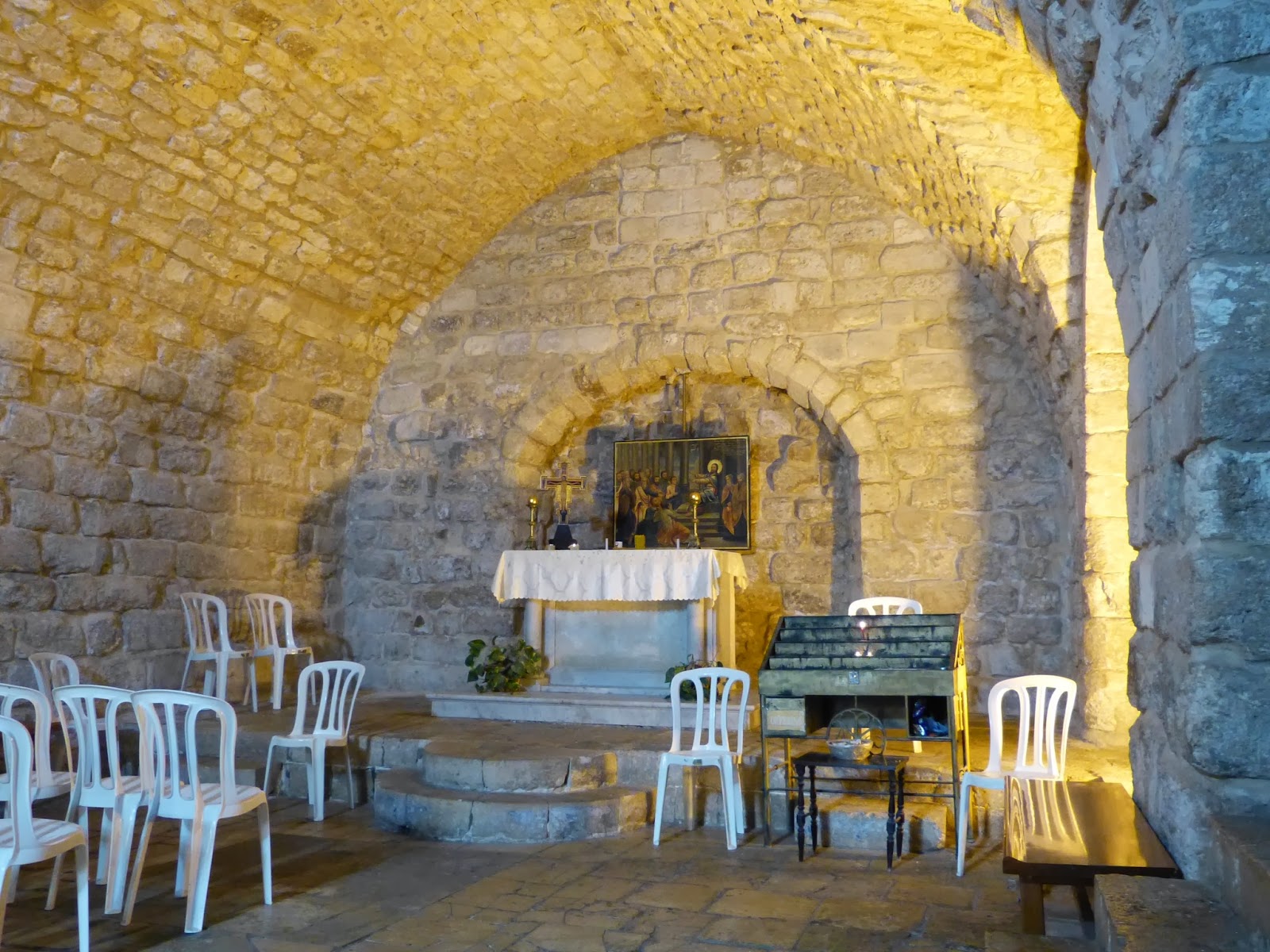
Holy Sepulchre, from Temple Mount - minaret of Mosque of Omar to left.


Observant Jews are forbidden to go onto Temple Mount, as no one is absolutely sure where the Holy of Holies was, and because they can’t complete the full necessary ritual purification, which involves being sprinkled with the ashes of a perfect red heifer, killed and then incinerated. This sounds the opposite of purification to me, but there you go. I can’t see how washing helps either, unless your mind is pure. (That’s my Christian teaching speaking, I know. It does stick.)
The Golden gate from the Mount of Olives


There’s a bit of the Haram you aren’t allowed in, and I don’t know why, since it seemed to be just garden; it was the bit towards the Golden Gate which is closed until the Messiah enters in, so whether that has something to do with it……………..  but it seems improbable.

Door of Al Aqsa
Al Aqsa


There are quite a lot of Byzantine columns and arches, and Al Aqsa which was a Crusader church has magnificent Crusader style doors. There is a kind of subsidiary Dome of the Rock, with open sides, not enclosed, called the Dome of the Chain, in the same style, with a magnificent mihrab. 


The Dome of the Rock is strikingly beautiful, and of course the views are tremendous.
Mihrab, Dome of the Chain


The Dome of the Rock and the Dome of the Chain

We left by Bab al Sisila (the Cotton merchants Gate); a clearly Mamluk  gate from the Haram  led straight into a very old souk in a sort of tunnel, which had sold cotton and now was largely sweets, and then to a gate at the other end which was clearly Crusader. The Jerusalem Arabs seem to have a passion for sweets.
Bab al Silsila


The Mamluk gate

Bab al Silsila - the crusader gate


The really thrilling thing about Jerusalem is the layers upon layer of history. So I'll finish with some pictures:
Byzantine Capital


Roman Aesclepium, over Pool of Bethesda
Post box, from the British Mandate
Zion Gate with damage from 1948 fighting

Damascus Gate
Modern wedding shop

Jerusalem - the Galilee trip

We had decided that in order to get to Nazareth and Capernaum (Nazareth! Capernaum!) we would have to hire a car and then stay a night. It all went quite well, although finding the hire car office was a bit of a challenge. There were masses of police around the King David Hotel, and more at motorway junctions as we set off, so maybe there was an important visitor (maybe Tony Bliar on his mission to bring peace to the Middle East, as if, and make a lot of money while he’s about it.)

We had quite a simple drive to Nazareth; as I said, the driving is illmannered (tailgating, middle lane hogging and such) rather than scary. We passed signs to Ashkelon and Ashdod, and Armageddon and Beersheba, and passed the Horns of Hattin where Saladin defeated the Crusaders.  It was all terrifically exciting. 

Nazareth itself was very busy. Our first stop was the Church of the Annunciation. It’s Greek Orthodox, and their tradition is that Mary was fetching water from the well when the angel appeared to her. There’s a seventeenth century church with high quality icons, in front of a fourth century crypt in which is the only year round spring in Nazareth. So whether or not it’s the site of the Annunciation, Mary must have used that spring, on that spot. The crypt is filled with the sound of running water, and genuinely felt peaceful and holy. Some Russian pilgrims were filling bottles to take away, but they were quiet and devout, and didn’t detract from the atmosphere.


The Church of Mary's Well

Then we went into the Old City – smaller but just as confusing as Jerusalem – and found the synagogue church, a very plain Crusader church built on the ruins of Nazareth’s ancient synagogue.  It seemed to be off the pilgrim run and so we were alone, and it was another experience to raise the hairs on the back of your neck.


The basilica

The chapel over the Nazareth synagogue

The main pilgrim site is the Basilica of the Annunciation, built in the 1960s, a most striking and beautiful building, over the ruins of Byzantine and Crusader churches, which are in turn over the remains of ancient houses, one of which is supposed to be Mary’s. Apparently there are ancient graffiti, dating from the second century. But something about the church, perhaps the Marianism offending my Protestant upbringing, made me resistant.


The guesthouse was also in the Old City and we had problems finding it. I was reminded of the old joke – Why did Moses lead the Israelites through the desert for thirty years? Because he was a man and wouldn’t stop to ask the way – but we found it, and it was very pleasant and the breakfast the next morning was superb. There was a chopped avocado dish, with a little very finely chopped spring onion and, I think, za’atar, and I was all set to make it here in England, but then I remembered that it’s impossible to get decent avocados here. I think they’re irradiated to stop them going off on the journey. You certainly can’t get avocado stones to grow any more. 

Nazareth feels more relaxed than either Bethlehem or Jerusalem, although there are, we’re told, tensions between Muslims and Christians. It’s apparently a foodie centre, and we had an excellent meal, served by young women with loose hair and trendy clothes. The Muslim girls coming out of school usually wear headscarves, but not always, and some wear one of those raincoat over everything outfits. But I don’t see what’s modest about covering your hair while wearing loads of heavy makeup.

The next day we set off for Capernaum and the Sea of Galilee. The first stop
Garden and vineyard at Cana in Galilee
was Cana in Galilee. Two churches claim to have jars from which Jesus turned water into wine. I can’t say we were convinced, but to be in Cana was exciting in itself. Of course the tourist shops sell wine, specially labelled.


Next, we stopped in Tabgha, where there is a church said to be on the site of the feeding of the five thousand. I wasn’t expecting to be impressed, but we were. In the fourth century a pilgrim described the place and the oral history of Christians in Capernaum, who venerated this as the “lonely place” on the shores of the lake. A church has existed here since, at latest 350 A.D., with the rock said to be the one on which Jesus blessed the loaves and fishes underneath the altar. 

The Altar at Tabgha, with the rock of the miracle under it.
So whether or not it’s the actual rock, it has been venerated as such since soon after Jesus’ death. A lot of the original Byzantine mosaic floor has been preserved, it’s lovely. It was quite a spot. It had power. There’s also a Church of the Beatitudes, said to be on the site of the Sermon on the Mount.
The beautiful mosaic floor at Tabgha.


We reached the Sea of Galilee. It’s more than 200 metres below sea level, so it was warm but still misty and rainy, so we didn’t get the views. 

Me, at the Sea of Galilee!

Tiberias was the Roman H.Q. and is now a holiday resort, but I have to say it made Scarborough on a wet weekend in December look good, and we’ve seen enough Roman stuff not to bother stopping, so we went straight on to Capernaum. That was terrific. There are the excavated remains of the ancient town and a rather lovely modern church built over the remains of two previous churches, which in turn enclose the remains of the house said to be Peter’s. 

Modern church

The remains of Peter's house underneath

Again, the first and second century graffiti, the sense of place, made us believe that this is the place. It’s the strangest feeling, that here you are on this spot, which is not a hypothetical or fairytale place, but solid and real.


There’s also the remains of a very posh fourth century synagogue, interesting in itself, but built on the foundations of an earlier one, where Jesus preached.
The black basalt foundations of the early synagogue at Capernaum
Not as shivery an experience as Tabgha and Peter’s House, but still mind boggling.

On the drive back to Jerusalem, which wasn’t direct, because we aren’t allowed to take the hire car into the occupied territories, we passed a Crusader castle, Belvoir. We turned up a mountain road and climbed and climbed. The castle is half a kilometre above the Jordan Valley, but it was too misty for what should have been spectacular views. The castle belonged to the Knights Hospitallers, and had a huge moat carved of of the basalt, which had then been used to build the fortress. 


It had withstood an eighteen month siege by Saladin after Hattin, but fell when the Muslim army sapped and collapsed the barbican. It used to be the site of an Arab village, but in 1948, the village was dismantled and the area around the park was turned into a national park. We didn’t know that, and it was one of those deeply depressing facts we kept finding out as we researched the trip and travelled.


It was a bit of a relief to return the car no more bumped and scraped than when we’d picked it up, and to the right slot in the underground car park. As we came back to Jerusalem, we realised that the car park had two entirely different entrances and we had omitted to take note of which one we wanted, which gave us a nasty moment or two, until Phil cleverly spotted a small sign.