Thursday, 10 March 2016

Blood

I have been giving blood since I was eighteen, but on and off. Mostly off, because for years and years I was disqualified for reasons of pregnancy, and having a child under one, and having been exposed to some illness. With four children, this was pretty much the usual state in the family. They didn't even manage to all have chickenpox at once, in spite of me putting them in the bath all together. We still had three bouts.  Then Phil was often away. I wasn't prepared to get a baby sitter so I could go to a blood donation session, and although the centre said children were welcome, I'm pretty sure they didn't mean four all at once. And the two older boys would have had a fight. 

But in spite of this, I've managed fifty seven donations. You can keep going until you're seventy, as long as you are well, so I might make seventy donations. My target was fifty, so I shall be thrilled if I can do seventy. When I retired I considered platelet donation. It takes longer and one has to attend more frequently, but I thought I would have the time. But when the nurse heard I have  number of children, she said she would run the test to see if I was a suitable platelet donor if I wished, but that she was sure I wouldn't be suitable. Apparently it's to do with acquiring antibodies (or something) in pregnancy. I'm more than a bit vague about it, to be honest. But when I thought about it, I realised that I'd never seen a female platelet donor. They're all men. 

Two or three years ago I joined something called the "Interval" study. Donors were allotted a set interval for donations. Mine is every sixteen weeks, which is pretty much the same as previously, when I was donating every four months. Some people are on a twelve week interval. I have my doubts about the study. In some ways it seems a bit wrongheaded. The proportion of people who are eligible to donate blood who actually do so is very small. So maybe it would be better to get more people participating, rather than getting the ones who are already doing their bit to do more. 

The study also means that I get questionnaires on how well I feel and can function, what I eat, and suchlike. Apparently the NHS is an amazing resource for researchers because it has access to  huge and unselected population, whereas of course, a lot of the statistics on health quoted  by other countries are based on selected samples. 

I'm O rh+, which is pretty boring, but they say I'm very useful. And they say "Ooh, you've got lovely veins."  It's difficult to know what to say to this - whether to simper thanks, or just say yes, I know. That sounds conceited, but after all, it's nothing I can take credit for. It's just luck. 

I'm also lucky, up to now, that my iron levels stay just fine, and I have never fainted in my life. Still, giving blood allows me to eat black pudding and steak and kidney pie and feel virtuous doing so - something that, alone, makes it worth donating. 


Monday, 1 February 2016

Two exhibitions

Of the art galleries in Nottingham, we consider the Djanogly, which is part of the university of Nottingham, the best. It isn’t very big, but that’s good because a really big gallery can be far too much. It’s OK in much of Britain because they are free, so one can drop in for a certain amount of time, or in the National Gallery one can decide to visit a certain section. I have been known to drop in just to see “Whistlejacket”.  But when entrance is expensive there’s an awful drive to somehow “get one’s money’s worth”  and not miss a single canvas, even when suffering from visual and intellectual indigestion.

The Djanogly is free and runs some brilliant exhibitions. The one on at present is works of the sculptor Elisabeth Frink. We booked in for a free gallery tour with the curator of the exhibition. It was wonderfully informative on Frink’s methods and inspirations, and although we like Frink’s work, we learned a lot, and looked at the sculptures with much more understanding after the tour. I particularly liked the eagle which she sculpted as the lectern for Coventry Cathedral, and her other animal sculptures of dogs and a horse. They were imbued with the spirit or character of the animal in a way that made them seem to be bursting with life. And I really liked “Standing Man”. I felt that a copy of that in your house or garden would act as your conscience. He was assessing  you, looking at you so narrowly it made you feel a bit guilty.

A couple of weeks ago we spent time in the Tate Modern, largely because it’s virtually next door to the Globe. Otherwise we wouldn’t have bothered.  Where on earth do they get this stuff? And are we paying for it? I fear we are.  And foreign tourists are not, even though the place seems to exist for them. The main turbine hall is full of triangular wooden open boxes, each containing earth from one of London’s many parks. Apparently the art lies in seeing what comes up. It’s an installation by some Brazilian artist. There are many problems with this :
  •        It’s winter, you idiot, and it’s inside where there’s even less light. Nothing is growing. Clot.

  •        Anyone with eyes knows what happens if you leave a bare patch of earth. You get weeds. You may get something that isn’t a weed and got in there by chance – a crocus for example.

  •       The earth from any London park is going to produce much the same as the earth from any other. Some may produce brambles, some may not. But that’s about it.

  •         Dropped litter is apparently OK. It’s one of the interesting differences according to the artist. Certainly, the box with the empty crisp packet dropped from the floor above is presently the most interesting box, but it’s NOT ART.


The Tate Britain is excellent though. And the turbine hall at the Tate Modern is well worth seeing, if they haven’t mucked it up with stupidities.  Which they usually have.


Tuesday, 19 January 2016

Two down, one to go.

I am really excited to be able to report that we are now down to just one Shakespeare play that we have not seen on stage.  That’s Henry VIII still outstanding. The RSC seems to be including The Two Noble Kinsmen as having sufficient of Shakespeare’s writing to count, but we haven’t decided what to do about that, yet.

This weekend we bagged Cymbeline and Pericles Prince of Tyre. Last summer at the Globe we decided to check what was going to be on at the Jacobean indoor theatre during the winter – it’s officially the Sam Wannamaker Playhouse – and were thrilled to discover that they were putting on a series of Shakespeare’s late romances.

We saw Cymbeline first and Pericles the next day; we enjoyed Pericles more. They are similar in lots of ways – unlikely plots, amazing coincidences, people reviving from apparent death, separations, near miraculous reunions, lost and found daughters – and in changes of tone, from near pantomime to deeply emotional. But we felt that Pericles was the better production.  The first two acts of Pericles are by George Wilkins, and you can hear when Shakespeare takes over and the verse suddenly becomes much more flexible. Wilkins is tum ti tum ti tum.

It was really interesting seeing how the indoor theatre worked, too. It’s even more uncomfortable than the Globe, and I shouldn’t think that there’s a single seat from which you can see all the action all the time. There is a little light coming in from the windows, but they are in the corridor round the actual theatre space, and so it’s not much, especially in winter, and there are shutters if they want to completely darken the theatre.  There are six large chandeliers which can be raised and lowered, almost to the floor if necessary, and candles in sconces on the pillars around the playing space. They use beeswax candles, you can tell by the smell, and therefore the light is brighter than you might expect, with a lovely golden glow, and no smoke. Occasionally the candles have to be trimmed or relit after being quenched and the stage hands and cast are remarkably quick, efficient and unobtrusive. No doubt they have special “candle training”. 

 Sometimes the theatre is darkened and an actor uses a sconce with a couple of candles, held in one hand, to illuminate their face. I’m surprised no one has set fire to their wig! They also use a pearly make up at times, which apparently is authentic. I dread to think what they used to get the pearly effect in the very early seventeenth century. I have a sinking feeling that it was probably mercury.


It was all quite an experience. I couldn’t help thinking of the woman, Ruth someone, who does Victorian, and earlier, reconstructions on television. I remember her saying what a help the corset was in supporting her back for a lot of the jobs she had to do, and for the sitting up straight. (Not, of course, if you try for an eighteen inch waist.)  Anyway, I’m thinking of getting myself some authentic stays before our next visit to the playhouse. 

Saturday, 2 January 2016

My New Year's Resolution

I don’t really bother with New Year resolutions. I struggle to think of anything I think I might actually keep, for a start. But this year I swear I’m going to keep my one resolution. I am going to give up trying to grow tulips outside on the terrace of the flat.

This is quite a wrench as I do love tulips and they come in such gorgeous colours and varieties; I like the black Queen of the Night ones and the greeny white ones and the little parrot ones and the tall red ones – I would just  love to have them in flower outside my kitchen.  But, unfortunately, squirrels like them just as much as I do.

I’m talking about Canadian Grey Squirrels, here, of course (we still call them “Canadian” because you have to blame someone for the destructive little devils).They’ve completely supplanted red squirrels over most of England. In fact I’ve only see a red squirrel a couple of times in my life, whereas the grey variety are pretty hard to miss. They empty a bird table in ten seconds. If you put out fat balls, they run off with the whole thing the minute it appears. Bird feeders, even those designed to be squirrel proof, might prove a problem to them for a few days, but then the wretched animals will find a way to snaffle all the nuts and seeds at one go.  If you bang on the window they gaze indignantly at you. “Can’t you see I’m working here?” The only way to scare them off is to run outside yelling. This is likely to lead other people to be alarmed, in fact much more alarmed than the squirrels deign to be.  Especially when one runs out in one’s pyjamas.

Unfortunately squirrels are very fond of tulip bulbs. Daffodils and hyacinths are poisonous, so that’s OK – I would positively encourage the squirrels to eat those, but sadly they know better. When we were in our old house, I used to cover the soil over the tulip bulbs with a thick layer of dried pelleted chicken poo. That kept them off!  It smelt horrible, but it lasted all winter, was presumably good for the bulbs, and the garden was big enough for it not to be a problem for us. The terrace isn’t that big, and pots liberally covered with chicken poo so close to one’s windows are not appealing.

Phil was so fed up with their cheek, he sent for a squirrel trap. Unfortunately he hadn’t considered what he would do when once he caught a squirrel. It’s against the law to release them, so if you catch a squirrel you are faced with the choice of killing it or keeping it as a pet. The second option appealed to neither of us. Phil thought he could kill any he caught, but I pointed out that the RSPCA says that the only humane way to kill a squirrel is with a sharp blow to the head. Well, that was never going to happen. The squirrel would be rocketing about the cage shrieking while Phil tried to beat it to death. So we got rid of the squirrel trap.

After it had gone, a neighbour, a pleasant elderly lady, confided that she had a squirrel trap. Having caught a squirrel, she introduces one end of a plastic pipe into the cage. The squirrel runs down the pipe and into the sock she fixes at the other end. Then she whams the sock on the ground. One dead squirrel, humanely killed and already in its shroud. This made us realise we are not cut out for hunting.

This autumn just past, I went into the market for something else entirely, and was led astray by the tulip bulbs. I chose a lovely selection, four varieties, two to bloom together in one pot, and another two to bloom a little later in the other. I also bought some strong plastic netting. I planted the bulbs and covered the pots with four layers of netting, held down with pegs, and secured by plastic string tied tightly over the netting and round the top of the pot.


All seemed to go well. The squirrels paid very little attention to the pots. Then one day, just before Christmas, I came back from a day out to find the netting and string vanished, the pegs cast aside, and every last single tulip bulb eaten. So I really do give up. I can’t stand the disappointment any more.

Wednesday, 30 December 2015

Nottingham trams

The Nottingham tram network has been expanded – there are three lines now – and although the building has been absolutely agony, with roads closed for months and monumental traffic jams, and shopkeepers along the route nearly suicidal, the end result, I think, is excellent. Of course, being a city resident and old, I don’t  pay, and this probably sways my judgement.  They have thought to put    a park and ride car park at each end of all the lines, and one line is highly convenient for my daughter’s house, and that convinces me that it’s really well planned.

But what I’ve been particularly enjoying has been spotting the names of the trams. It’s kind of a crash course (not literally, thank goodness)  on the history of Nottingham people, and who is considered worthy of having a tram named after them.

Of course, there’s a Robin Hood, but there are a number of writers, which is quite appropriate since Nottingham has just become a UNESCO City of Literature. I have no idea why Nottingham, more than other cities, or what it means for the future, but it’s kind of nice. Anyway, the writers who have trams named after them are Lord Byron, Alan Sillitoe and D.H. Lawrence. None of the still living Nottingham writers have been honoured with a tram. Perhaps there’s a worry that they’ll go out of fashion. I really like Jon McGregor, but he wasn’t born in Nottingham. However neither was Byron. 

There’s also a tram called after a successful screenwriter, William Ivory, formerly a  Nottingham dustman, and one for Stephen Lowe the playwright and director. And while we’re on the stage, there’s a Vicky McClure, named for the actor. She was a member of the Childrens’  Television Workshop, along with Samantha Morton, Jack O’ Connell, Joe Dempsie , and many other successful actors. Oldest son went there – he loved it, and also made quite a bit of cash from doing  bit parts in TV dramas, although he ended up being an accountant.

Then there are scientists. There’s an  Ada Lovelace; she was Lord Byron’s daughter and a pioneer of computing (I did actually understand Bernoulli numbers when I took a little historical walk which included her grave, but as soon as I didn’t need to understand them, they went.)

 George Green has a tram and an engineering building at the university named after him – he was a largely self taught  mathematical genius, and  you can visit the windmill in Sneinton  where he was the miller, and which has been restored. The storage buildings on the site have been turned into a little science education centre. As a lot of his work is on electricity and magnetism, there are lots of fun things to do. It’s quite a good place to take children.

Another scientist with a tram is Sir Peter Mansfield, who developed the MRI scanner. He failed his eleven plus exam and failed to get into grammar school, which just shows how rubbish the system was, and how stupid it is for those Conservative idiots to want to bring back grammar schools. Not that grammar schools have gone away entirely. They are popular with parents who are sure their children will pass the exam and then won’t have to mix with the riff raff. Personally I think learning to cope with all sorts of people is an important part of education.

 There are trams named after quite a lot of different  sporting types. There’s Brian Clough, manager of the Nottingham Forest side who won the European cup two years in succession, and Viv Anderson who was the first black footballer to play for England. There is a tram called Torvill and Dean, after the Nottingham Ice dancers who scored perfect tens at the Sarajevo Olympics. Why they didn’t get a tram each, goodness knows.  Although they did move in perfect unison ha ha.

There are two boxers -  Carl Froch, the world super middleweight  champion, and one named  Bendigo after the all England bare knuckle champion. He was one of triplets who were named (naturally) Shadrach, Mesach and Abednego, and therefore became famous as Bendigo;    and had a serious drink problem in later life. I don’t think he can have been punchdrunk, as bare knuckle boxers couldn’t hit as hard. It would simply break their hand. But some of his fights went on for over a hundred rounds, which I shouldn’t imagine does your head much good. Anyway, later still, he stopped drinking, got religion and became a lay preacher.   So a happy ending of sorts. Bendigo in Australia is named after an Australian fighter who was named after the Nottingham Bendigo.

Sid Standard is also a sporting hero, but he isn’t famous for winning, but for getting kids into cycling. So really a more worthwhile hero than many others. And David Clarke of Nottingham Panthers ice hockey team has a tram.

The latest sporting hero is Stuart Broad, who took 8 wickets for sixteen runs in the Ashes here in Nottingham at Trent Bridge last summer. Actually, it was a bad thing for Nottingham in some ways, because all the people who’d travelled to Nottingham to see the match went home. Instead of five days it lasted two and a bit, so the city must have lost money on it. But I can’t tell you how satisfying it was to see the Australians collapse.  A tram was immediately selected as the perfect tribute to a wonderful display of bowling, and to everyone’s joy at thrashing the Aussies.

One tram is named William Booth, after the founder of the Salvation Army, born in 1829 in Sneinton, Nottingham. There are lots of local people you won’t have heard of, but who have trams named after them as a tribute to their charitable work, which is a really nice thank you to them. One is named after a lady who has volunteered for Homestart, which provides support for struggling families, and when the Nottingham Evening Post asked for nominations for people to have trams named for them, the family she has supported for years immediately nominated her.  And some are named for nurses and midwives who won nurse of the year awards.

A very important  businessman commemorated with a tram is Jesse Boot, founder of Boots the Chemist, still a big employer in the city, and an important city benefactor, helping to get the university started and giving it a great deal of land.


Then there’s the tram called George Africanus. He ran various businesses in Nottingham, including a servants’ registry. He was brought  to Britain from Sierra Leone as a slave in 1766, when he was about three, but died in 1834, a well known and prosperous businessman.  And there’s Sat Bains, who runs a Michelin starred restaurant.  I haven’t been there - whenever I suggest a posh restaurant, Phil says he won’t pay that when he eats better at home. Huh. Flattery.  And stinginess. Still, he's lovely really.

Tuesday, 13 October 2015

Catch up, October.

I have got really out of the habit of my blog, but I'm away in France, visiting friends, and I have time to catch my breath and spend time reflecting and recording. First, why I haven't kept writing: I think I lost interest a bit, and it became a chore rather than something I do for my own pleasure. I have never cared much whether anyone reads what I write, but the act of writing encourages reflection and enhances memories. Also, I have been extremely busy and usually too tired by evening to do much but flop.

The reason for the hard work is that suitable new premises suddenly became available for youngest son's fancy dress shop. It is very well positioned and has excellent windows, and really rather good shop fittings. So all that was good. We did have to get a joiner in to build some changing cubicles, and a locksmith as one of the double doors wouldn't open, and a plumber to fit the washing machine, and such like. But the only problem was that it was extremely dirty. Luckily August is a quiet time in the fancy dress trade, so Phil, Dan and I turned to, and scrubbed and cleaned, and second son and his lovely wife painted, and between us all we got the place clean, fresh, and, although I say so myself, looking great. And can I recommend Barkeeper's Friend for brass and Sticky Stuff remover as sold in John Lewis? They are amazing. And if you want to see the result:

http://www.themagicmirror.co.uk/

The new shop isn't quite as big as the old one, so Dan had to cull the hire costumes. It hurt him, but a lot of old uniforms went to be sold, as they won't wash, and anyway,  rather few modern people have sufficiently narrow shoulders and waists, even if they are not too tall.  He also decided that he really didn't need two pantomime horses, and then, in accordance with Sod's Law, the third customer across the threshold of the newly opened shop wanted - guess what? - two pantomime horses. Dan managed to convince them to have a pantomime horse and a pantomime cow.

Anyway after hours of work, seven days a week, the shop opened and we went immediately into the university freshers’ fair, which nowadays involves themed fancy dress parties, so Dan was still working seven days a week, and our contribution was to look after Atlas, who was not able to go to the students' union. He is getting really good at the agility course, or the dog adventure playground as we consider it. He really can jump, thoroughly enjoys walking the beam and going over the seesaw, comes through the tunnels like a rocket, but can't see the point of threading through the poles, and has to be lured through with a treat in front of his nose.

We took the grandsons to the Lakes but also the dog, because Dan was still so busy. We enjoyed ourselves although the weather wasn't great.
Ullswater

Eden Valley
 It was better if we went west into Northumberland, so we discovered the Eden Valley, which is lovely and went to Vindolanda, which is excellent. A lot has happened since we last went with our children and a lot more of the vicus has been excavated, and the museum was well themed and displayed. We also went rock climbing, with a good instructor. Thomas turned out to be quite good at it, Marc was nervous, and I don't have a decent power to weight ratio. I was quite pleased with myself, when I got to the top, because it was much, much harder than a climbing wall. But I was less pleased with the photos Marc took. As Phil was off with Atlas, Marc was in charge of the camera, and as he was below me, his photos mainly consisted of an enormous bottom, outlined with climbing harness as emphasis.


Long Meg and her Daughters stone circle, Cumbria
Then when the shop was open and going rather well, Dan completed on the house he is buying. We knew the previous owners smoked and had a dog, so we sort of knew it didn't smell good, but went we went to see it all the windows and doors were open and it was OK. Once it was empty and closed up we realised the extent of the problem. Poor Dan said he lay awake all night thinking he had made a terrible mistake. But the next day, Phil took up the living room carpet and took it to the tip, and I started to wash walls, celings, inside cupboards, light fittings and in fact everything I could see. So we’re half way towards the house being as nice as we thought it could be when Dan bought it, but had to break off for our trip to France which was actually well timed, as it enforced a rest.


We had a lovely time with our friends, who live not far from Orange. There’s one little hilltop town after another, where the Gallo-Romans retreated as the barbarians swept in, and they are all charming. There’s some great wine, too. I have extremely happy memories of a bottle of Gigondas at the restaurant we ate at in Fontaine de Vaucluse. We had a lot of sunshine, too.

Fontaine de Vaucluse


The sausage stall, St Cecile des Vignes
I also had time to read. We recently went to see the Oresteia at The Globe. Clytemnestra was wonderful. Not quite so sure about the way they managed the chorus. But it pushed me into reading Barry Unsworth’s  “Songs of the Kings”, about the sacrifice of Iphigenia. It’s wonderful – slyly commenting on modern politics. I do hope Tony Blair ends up at The Hague – it’s the one policy of Jeremy Corbyn, the new Labour leader, that I am wholly in favour of. 

Anyway, we got back to England rested and ready to get stuck in again. Autumn is definitely well under way.

Friday, 3 July 2015

Cornwall

It is suddenly summer, and we decided to have a trip away, in Cornwall. We drove down as far as Bristol in the evening after grandparental duties, so that the first proper day of the trip was fun. We had a look around Truro which is a pleasant town, if not particularly distinguished. The cathedral is Victorian in perpendicular Gothic style, again, pleasant without being special.

Then we went to Trelissick. The National Trust has started to open the house but it's the gardens and the site which are worth seeing. The gardens have lots of subtropical plants such as tree ferns, and they have winding shady paths which open onto spectacular vistas over Falmouth Roads. 
Trelissick gardens
We pottered around them for ages, and really enjoyed the orchard, which had an old cider press and was full of unusual apple varieties with weird and wonderful names, such as the variety Pigs Snout. It isn't the most appealing name for something one plans to eat, although I think it is a cider apple.

We had dinner at the hotel, because we were quite tired and didn’t want to go out again. We didn’t expect the food to be anything great, and it wasn’t, but that was as expected. What was annoying was the service - it was shockingly slow, even though they clearly had us down as trouble makers, and were doing their best to get us out. We got a tenner off the bill, but would far rather have had a swifter meal.

The next morning, at breakfast, it seemed beyond the staff to replenish supplies of croissants, supply boiling water for tea, or pots to make it in, or clear tables. Luckily we had opted for a continental breakfast. This was a good decision, as the English breakfasts took forever, but I was beginning to feel really stressed, as Phil spent too much time in the US to tolerate slow service, and isn't inhibited by the usual English terror of causing a fuss and complaining. I still am. I was itching to take over and organise the useless crew, although to be fair, the physical arrangements of seating, the kitchens, and the buffet were working against the staff. So I was beginning to feel that a holiday punctuated by regular rows with the serving staff was not going to be fun. But, apart from that one hotel near Truro, the service was fine and we had some really excellent meals.

After breakfast, we went to the National Maritime Museum in Falmouth. This is the Cornwall branch. It's pretty newly built and is just brilliant. We particularly wanted to see the exhibition on Viking seafaring, because we went to a talk in Nottingham by the curator of this particular exhibition. He is the Curator of Coins at the British Museum; he was talking about assessing treasure trove, and it was a very interesting talk. He mentioned the exhibition and we thought it sounded good, and so it was – really lively and informative.  But there was much else in the museum that was completely fascinating, and we were in there for ages. 
The Royal Fleet Auxiliary Mounts Bay
One nice touch – there’s a lookout tower to see right across the harbour, with an useful crib sheet to help one spot interesting vessels. There is HMS Tyne, a fisheries protection vessel and a Royal Fleet Auxiliary landing and transport vessel; there’s the Ernest Shackleton, a scientific survey vessel; there’s all the little ferries crisscrossing the river, and there are some J class racing yachts, with vertiginously tall masts. We saw one sailing, with about eight men out on trapezes balancing her up.

At last, we were museumed out, and had a very late lunch at Rick Stein’s restaurant. What we had was good, but I was quite disappointed at the choice of fish. If you are eating in a posh fish restaurant you'd expect a wider range of fish on offer than cod, mussels and crab. I mean, I personally can’t stand skate, but it was on the menu elsewhere. And we also had bream, hake, mackerel, sardines and squid at other meals.

The following day we went back into Falmouth and took the ferry across to St Mawes, and then a second, smaller ferry to Place. It was a morning of heavy sea fret, so that the lighthouse fog horn was sounding, but we still really enjoyed the boat trips. 
The Lighthouse. The small white building is the former store
for paraffin, to keep the light burning. 
Falmouth is one of the largest natural deep water harbours in the world (if you look on the internet there’s some agreement, but also there’s obviously quite a bit of disagreement about  how “size” is measured when it involves a sea inlet). The ferry trip across takes about twenty minutes, and was a bit splashy, which made it all quite exciting.  By the time we got to Place, it was brightening up, and we set off for a circular walk, the second half of which was on the South West Coastal path, and took us past the lighthouse, still honking away,  and a thirteenth century church. It was thoroughly good, with profusions of wild flowers and larks singing.


At the end of the walk, we got the ferry back to St Mawes, and watched the Falmouth Diving Club getting volunteers to go into the water in an old fashioned diving suit. It took ages to manoeuvre a volunteer into the suit, and the helmet was fixed in place with wingnuts. It wasn't for anyone who had even the slightest tendency to claustrophobia.

We spent a while looking at St Mawes Castle, 

which was built by Henry VIII as a state of the art artillery fort to protect the entrance to the port. There's a matching fort on the other side, and other sixteenth century fortifications. It's interesting because most of the Tudor stuff has survived. Of course it was the site of Victorian and World War Two artillery batteries, but they left the fort much as it was. We enjoyed seeing it more than we expected. There are some World War Two pillboxes left, and the Fisherman's Quay at Falmouth is huge, so I think it must have been enlarged for D Day. The Pickle landed here bringing the news of Trafalgar, but the main memorial is to the naval and commando forces involved in the St Nazaire raid - the raid which denied a dry dock to Tirpitz, so that it spent the rest of its war uselessly in a Norwegian fjord, until finally sunk by the RAF. 


WW2 pillbox
In fact we're enjoying Falmouth very much. Last time we came to Cornwall, we went to St Ives, and it was full of pretentious London yahs, who seemed happy to pay silly prices for very mediocre meals, and having given their children idiotic names like Orlando and India, felt that paying the poor kids any further attention was unnecessary. We didn't enjoy it. Although to be fair, we did see a sunfish. So Falmouth is delightful. Also we have had excellent food which always makes us happy.

For the next two nights We moved from Truro to Bodinnick, across the river from Fowey, and stayed at the Old Ferry Inn. It's great. 
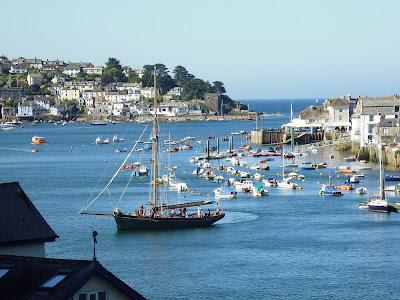
 Polruan - the view from the Old Ferry Inn
The food is seriously good and imaginative, and it has fantastic views. Our bedroom is pretty low ceilinged though - it wouldn't do for a six footer. But it's fine for us.

A nice point is that both Falmouth and Fowey rivers are really busy. There are always boats moving about, and the ferries alone create a sense of purpose and interest. Not like most places, where the marinas are dead and alive, not a boat moving. You can sit and watch, while enjoying a drink. I had a pint of Rosie Pigg, which might be too much, as the stairs up and out of the pub were steep and irregular and presented something of a challenge afterwards. 
 
A traditional Cornish stile. It presented
problems to bipeds, so it would
certainly keep quadrupeds in their field. 
Because we are near the Eden Project, we decided we ought to go there. I don't think either of us had great expectations, but it was really remarkable, we’re so glad we went. The rain forest biodome was amazing. It's so huge you lose sight of the fact that actually you are in a massive greenhouse. 
Two of the birds introduced into the biodome to control
pests. There are lizards and another species of bird, too.

And the outside gardens are just wonderful, not just for beauty but also for education, such as the displays of plants used for dyeing or for medicines. The only slight disappointment was the Mediterranean biodome. There was a cafe in there, and the smell of the food drowned out the smell of the herbs, and spoiled the experience. But in general, it was great, much better than we had anticipated.

The we went for a walk down to the beach which was at the end of the gardens of  Menabilly, the house occupied by Daphne Du Maurier, with the boathouse that features in “Rebecca”. It was a lovely walk and a pretty cove, and I had a swim, which I enjoyed very much.

The following day we walked a route from Bodinnick via Pont to Polruan, where we got the ferry cross to Fowey, and then walked through Fowey to the ferry back to Bodinnick. It's a well known walk and is very beautiful, walking through woods which sometimes open on to superb views of the river. Fowey is another deep water natural harbour and has been important port since the thirteenth century. It was another D Day port -apparently there were so many landing craft in the river that you could walk across dry shod. Polruan has the remains of a blockhouse dating from the fourteenth century. It has some artillery emplacements and there was a chain across the harbour entrance to a matching blockhouse on the Fowey side. There's not much left of the Fowey one.
Fowey
Fowey is very pleasant. It has lots of shops for well heeled tourists, of which there are lots. What with the narrow lanes for driving and the narrow streets in the villages, I would definitely avoid high season.

We bought Cornish pasties, because we hadn’t had one so far and picnicked on them at the car park for Lantic Bay. It is a lovely beach and the view down from the cliff was glorious. Going down to the beach was very hard on the knees and climbing back up was hard on the lungs. We felt feeble, as there were families with small children, buckets and spades, picnics, barbecues, parasols – you name it, toiling up the path. The weather is sunny and quite hot, although there's a very pleasant breeze, and between larks, wild flowers, and views over a sea shading from a navy blue, through deep turquoise, to light blues and greens, it was most beautiful.
Lantic Bay

I had a swim and Phil sat patiently. He is good, accommodating my desire to swim even though he hates swimming himself.

There was thrift growing on the rocks - those pink pompom flowers that used to be on the reverse of the threepenny bit. Growing in profusion, they made a fine show.

On our final day, we went for another walk – you can easily cut across inland and return by the South West Coastal Path – had a really good lunch in Falmouth, and then went down to Readymoney cove so I could have a last swim. As I walked down the beach and entered the sea my internal monologue went something like this:
“ Oh, look, a jellyfish. Oo, that’s a big jellyfish. Heavens, that’s a massive jellyfish. Oh look, a purple jellyfish. That big one is more red than purple, it’s like a plate of liver. Actually, I’ve never seen so many jellyfish ever before. I’m not swimming in that lot.”


And I had to plod back up the beach, having only got in up to my knees, and even that was too far, as I have a large sting just above my knee. I shall have the sore patch for weeks, it’s like a burn. So that’s an unfortunate memento of what otherwise was a brilliant short break.  But at least we are sold on Cornwall again.