Saturday, 28 September 2013

Two more Shakepeares

We’ve just been to Stratford to see two less popular plays, Titus Andronicus and All’s Well That Ends Well. It was a lovely trip. First, Stratford has a lot of clothes shops aimed at women of a certain age, all within a shortish walk, and I always end up getting something. This time it was a dress which I’m very pleased with.

Then the weather was lovely, a really warm Indian summer, so we bought picnic food and ate it by the river. There was a slight problem with that -people feeding the geese and swans with white sliced bread. Most places ask you not to do so, pointing out that bread is bad for wildfowl, and it made me a bit edgy, but not enough to dare to actually spoil peoples’ fun. There should be signs explaining the problem, as there is almost everywhere else; but Stratford has so many geese and swans it’s possible that the council prefer a few to blow themselves up and die, rather than that they arouse the wrath of the animal rights people by culling them. Actually, having thought about it, perhaps they can’t cull the swans without the Queen’s permission.

The two plays seem to have gone through an unpopular patch, but actually modern sensibilities mean that they are more accessible now than they were at one time. Titus, in particular, with its extreme violence and revenges taken, fits rather well with the Tarantino school of movie making. There were some rather hysterical bursts of laughter from the audience when matters became excessively bloody. Titus himself responds to the deaths of his sons with laughter.  So I appreciated it more than I expected I would. The whole cast was excellent, and the wonderfully choreographed orgy of murders at the end was stunning. I’m not sure that I want to see it again – a lesser production would either be simply horrible or laughable, not manage the trick of being both.

One thing I did like, and it added to the slightly surreal feeling of the play, was that the Goths were dressed as modern Goths, with the same huge platform boots and black lipstick. I think I enjoyed it, if that’s quite the right word, better than my husband, who has a low tolerance for blood. But he’s recovered quickly – when we got back to Nottingham and ate out, he ordered pie! It might be a while before I fancy pie. 
   
All’s Well That Ends Well also seemed a bit unpromising, but again modern ideas about men who refuse to grow up, women making close alliances and being more mature and organised than men, all mean that the play is more understandable for modern audiences than it probably was, certainly in Victorian times. And the production managed to put in a few moments, hinting that Bertram actually fancied Helena but was frightened of commitment, which made him more sympathetic. I don't mind the ambiguous ending. I don't see that it's a fault. The ending of The Tempest is ambiguous and people never seem to mind that. 

I thoroughly enjoyed it – the men were terrific . I was a bit unsure about Helena, but it isn’t a part with a lot of scope. The other women were great. Again the choreography was wonderful. It’s finished now, otherwise I would urge you to go at once.


So now we’re down to four definite Shakespeares (Cymbeline, Pericles, Henry VIII, and Love’s Labours Lost). I know Cardenio and Two Noble Kinsmen have been relatively recently decided to be at least partly by Shakespeare, but if we can manage the four definites we will be happy. 

Sunday, 25 August 2013

The Lake District

I’m recently back from a week in the Lake District. We took the grandsons, and number two son also came because he had spare holiday and wanted to swim in Ullswater. He was a massive help with the boys. It is easier in some ways to take them away, because everything is new. There’s no problem of saying where we are going for an outing and being answered with a wail of “We’ve been there!” But there’s no use pretending, we don’t have the stamina we used to have when ours were young. It does really make me wonder about the wisdom of women leaving it so very late to have children. I suppose they just have to manage. But the idea of dealing with teenagers in your sixties makes my blood run cold.

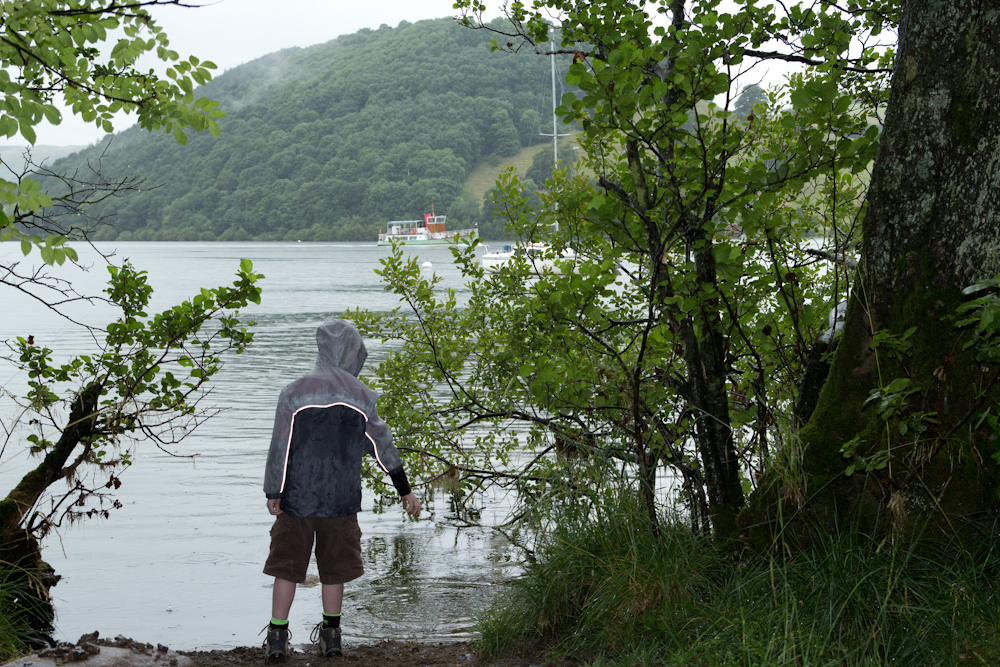
Our son swam every day, right across the lake and back, every morning. I swam three mornings, when there was sun; the water wasn’t as cold as I expected, but a bit of sun, even early in the morning, made a great difference. I haven’t got a wet suit and don’t want one. My ideal would be swimming nude – it’s the freedom I like.
The swimming spot.


Actually getting in to the lake was a bit of an issue – it’s a stony bottom, quite painful, and then after a yard or two, large and extremely slippy large stones. We were reduced to lying in the water and hauling ourselves over the stones by hand. It was quite undignified, and made us feel like seals – all slick and graceful in the water and them lolloping about in a clumsy way on land. Water shoes would have helped of course, but I don’t like swimming in them, either.

The actual swimming was simply gorgeous. The water is lovely, brown and murky and very soft, and the views from water level down the lake as the sun lit the mountains was very beautiful and peaceful. One morning there was even a rainbow. I felt uplifted for the rest of the day. I wish I could start every day like that.

The weather was very decent for the Lake District, and so we suggested that older grandson might like to climb a mountain. He liked the idea, and so we took him up Helvellyn along Striding Edge, which was pretty ambitious for an eight and a half year old. He was fantastic – brave and determined, much better at going uphill than his granny. At the top he was definitely the youngest, and I was definitely the oldest. This was the first time either I or middle son had seen the view from the top; it’s always been too misty before. But this time it was wonderfully clear, and we could see Morecambe Bay.


The view from the top.

 I was really pleased, because it was a reward for our grandson, since it was his first mountain.  On the way down he did complain a bit about tired legs, but as he could still break into a skip and a run we didn’t feel too worried about him.  

Then we met my husband who had taken the younger grandson to the lake to paddle, and then to see alpacas, and then up Aira Force. So a pretty full day even if not a mountain.  We all went up Aira Force another day, right to the top – the boys are turning into excellent walkers.

Middle son also climbed Blencathra, but on his own, as we felt two mountains might be pushing it. He made it up and down much quicker without mother and nephew in tow!
Blencathra, from the mining museum - steam engine ride and dead diggers and cranes, plus fluorescent crystals - lots of boy and grandad appeal.

The boys are just about the right age for Beatrix Potter’s house, and I must say really enjoyed spotting the places in the books. Recently the younger boy has been enjoying repetitive readings of Samuel Whiskers, and loved the landing. We seem to have lost the copy of Pigling Bland, and there were a lot of pictures and even some genuine pig papers.  It’s Pigling Bland’s centenary. So we bought a new copy. 

It made us quite nostalgic - we remembered our son's favourite phrase, when he was about three or four, being from Pigling Bland – “ I wish to preserve them in case of emergency.”  I adopted Aunt Pettitoes comment about her family -  “They do eat – and indeed they do eat”!

Another highlight was Castleriggs stone circle. It's in the most beautiful setting, in a bowl of the hills, and the stones seemed to reflect the shapes of the mountains. Whether that was intentional on the part of the builders, or whether I'm imposing a pattern that doesn't really exist, I'm not sure. But I wasn't the only one who thought there was a pattern. The boys found it satisfactorily creepy. 

I've only a couple of photos, but hope to add a Striding Edge one when I get one from Will. 


The setting of Castleriggs stone circle.


Wednesday, 17 July 2013

York and Durham

I’ve had an exciting couple of days. First, we went to York for a weekend to see The Globe’s production of all three parts of Henry VI. We saw the first part on the Friday evening and the following two on the late afternoon and evening of the Saturday.

The Globe was keen to point out that the three parts are not written as a series, and the “first” part was written last, in my opinion was the weakest, and probably by Shakespeare alone, whereas he probably collaborated on the other two. But I do think we gained from watching all three in short succession – there was a tremendous momentum - the bloodshed gathering pace, so that forgiveness became harder and harder, and the hate became unstoppable. Henry is presented as a holy fool, but it is the country’s tragedy to have such a head.

The cast was admirable – they all took several parts except for Henry himself, and the amount of learning, and the work, of staging all three plays in a day was seriously daunting.  I thought the scene of Talbot and his son was too shouty for pathos, but that’s really my only gripe.

So then we went to Durham. Friends had booked us into see the Lindisfarne Gospels, which are on loan from the British Library temporarily. But, by mistake, they had booked for the day of the Miners’ Gala. Well, I’ve never been before. You just didn’t.  You stayed well away from Durham. The shops were boarded up; people weren’t used to being able to drink all day, so the atmosphere was pretty fraught.

Well now, it’s a pale shadow of its former self. There are no deep pits in Durham, only a little bit of open cast. The county looks so much better. Some of the pit villages are still pretty grim, but at least they don’t have spoil heaps lowering over them any more. So the Gala (in our day it was always “gayla”, but now it seems to be “gahla”, perhaps with foreign holidays) is a sort of big folk festival. 


Bands waiting to parade into the cathedral to have their banners blessed.

There are loads of brass bands parading with the banners, and rapper sword dancers, and a huge fairground, and there were still speakers haranguing the crowds, who were mostly not taking any notice of it at all. No important politicians as far as I could tell. The banners seemed to be carried by the womenfolk and hangers on of the bands. The young men were nearly all outside the pubs drinking and getting seriously sunburnt, but not nasty in any way – well, not by the time we left. One very good thing was that there were lots of young people of both sexes playing in the bands.

The exhibition around the gospels was very informative, with lots of other gospels and other manuscripts – I particularly fell for a small illuminated Life of St Cuthbert.  (I wish he was still England’s patron saint – a better and much less martial example than George, and he actually existed.)

So although the miners' gala (or Big Meeting Day) was not on the carpe diem list, perhaps it should have been, and I can't tell you how pleased I am to have gone. 


Both York and Durham look great, have great catering, and Durham has the best cathedral in England, almost in Europe. It was sunny, and everywhere looks better in sunlight, but these are world class tourism sites, and we tend to be blasé about our own stuff and overpraise the more exotic. If you've never been (lots of people have missed Durham) I urge you to go at once. 

Thursday, 4 July 2013

Honderribia and Biarritz

We’ve completed our Wellington plans, except for La Rhune, which we planned to go up via the rack and pinion railway; but we’ve scarcely managed even to glimpse the top though the low clouds, so we’ve decided not to waste the money.

So we took the little ferry across the Bidassoa to Honderribbia on the Spanish side. A boat trip is always fun, and although we clearly should have waited for low tide and waded across up to our armpits, we chickened out.
Crossing the Bidassoa


Honderribbia has a small but absolutely charming old town, with walls and a thirteenth century castel, now a parador. There’s a cathedral and quite a number of sixteenth and seventeenth century palaces. So we had an enjoyable walk round there, and then a walk along the river front. It’s a festival, and so most people were done up in Basque white clothes with red neckerchiefs, at least, and some were quite elaborately done up with espadrilles and berets.

A town house in Honderribia

Honderribia

Back across the river we went to a restaurant near the marina for lunch, jolly good, and then had a long walk along the promenade and beach at Hendaye – it was one of the sunniest days we’ve had.


We flew back from Biarritz, so left early enough to have a look round.  Phil had been there on business and wasn’t that impressed, but I wanted to see it. There’s a lovely beach, well kept, but rather dodgy streaks in the sea. There are still some Belle Epoque houses, but mostly it’s vast apartment blocks. There are rocky stacks, which have been joined by bridges to make sort of piers, and there’s a lot of attraction in a walk out along the pier. The massive and very posh Palace Hotel  is a Napoleon III relic. So I’ve seen it and agree with Phil!


A rock "pier" at Biarritz


On the flight I had time to weigh up what our Wellington trips have taught us.  The major conclusion I’ve come to is that Napoleon was a very wicked man. He was a monstrous egoist, who seems to have believed that ordinary people existed to be of use to him. He was utterly indifferent to how many men, women and children died horribly because of his ambition. Did you know he actually reintroduced slavery?

Wellington’s genius was hard work, careful, detailed preparation, and a care for his men’s lives, if only because he knew they could not easily be replaced. When he made his prompt decisions, he could do so because he had already researched all the possibilities. He never betrayed any uncertainty or lack of confidence, and his men soon learned to have enormous confidence in him.

The other thing that impressed me was the difference in attitude to war – the French, who committed terrible atrocities in Portugal and Spain, were nevertheless obsessed with ideas of honour and glory, which were already outdated in Britain. The  British seem to have seen the war much more as a job that had to be done.


Monday, 1 July 2013

St Jean de Luz

We decided to go to St Jean de Luz, because it was Wellington’s headquarters during some of the winter 1813 – 1814. Hostilities didn’t cease completely for the whole winter, but there were periods when the roads were impassable.

Well, I have to say we were very pleasantly surprised. St Jean De Luz is really pleasant. There’s a proper fishing harbour, not just a pleasure boat marina. (As an aside, I simply can’t get my head round marinas. They are usually packed with millions of pounds’ worth of boats, of which maybe one in two hundred are being used. In fact the boats often look as though they are never used, or maybe once a year, and they deteriorate faster than some other sorts of property.  So how does it make any sort of sense?)

Also there’s a very attractive old town, with lots of substantial houses built by pirates; one was used for Louis XIV, and one for the Infanta Maria Theresa, when they got married here.

The privateer's mansion used by Louis XIV
 We had a coffee in the main square, facing the Mairie, where there seemed to be a fairly constant stream of weddings, the women all clarted up like dogs’ dinners and the men mostly scruffily casual.

Wellington’s house was quite easy to find, although there's no proud plaque advertising the connection, as there were at his various houses in Spain and Portugal.
Wellington's house. Very Basque.

The commissariat was set up here, and each regiment was marched in to be issued with new uniforms. They were literally in rags, and it was winter. The supplies were brought into a deep water port, which the British called Passages, which confused us, but it’s just in Spain, and its real name is Pasaja. The wounded were sent home from here too, as soon as they were fit enough to make the journey.  Lots of entrepreneurs descended on St Jean de Luz, and the peasants were keen to provide cattle. There was a problem with what coin they would accept, so Wellington recruited 40 soldiers who had been professional coiners to melt down the available coins and turn out five franc pieces dated earlier in the century!

Then we drove through lovely countryside and lovelier Basque villages, stopping for lunch at Espelette, where they grow such superb pimentos that they are appellation controlee. The meal was Basque, and majored on pimentos, but it was good.

After lunch we went to Bera (if you’re being Basque) or Vera de Bidassoa if you’re being Spanish. It’s just on the Spanish side of the border. Here a French division retreating from an attempt to relieve San Sebastian, found themselves cut off on the Spanish side of the river, trapped by the river which had risen suddenly to flood levels. The only remaining bridge, at Bera, was guarded by Captain Daniel Cadoux and less than fifty men of the 95th Rifles. They held the bridge for more than an hour, killing more than two hundred French and their General Vandermaesen. But of course they were overwhelmed in the end, and the French division was able to escape to France. The Rifles never forgave General Skerret for leaving Cadoux and his men to be killed, and were very pleased when he had to return home sick.

Cadoux's bridge

As a nice touch,  British accounts stress the number of French corpses in the river, being nibbled by trout. Other diarists comment on the good fishing they had and the fat trout they caught and ate!

The monument to Cadoux and his men.


I think, judging by the villages, the Basques were usually prosperous. It might be mountainous, but the valleys are usually wide and sunny, not like the glaciated ones in Norway and Switzerland, and there’s mixed farming and lots of timber. Plus, of course, whaling, fishing, piracy, and smuggling.


Friday, 28 June 2013

San Sebastian / Donostia

We’re staying at Hendaye, which feels rather home like. It’s got a lovely beach and late Edwardian promenade, and the thing that makes it feel homelike is the wind; there are lots of people on the beach trying to get out of the wind, or trying to get out of wet swim suits, while wrapped in flapping towels. They need, but don’t have, windbreaks. I know the idea of going on a beach when a windbreak is needed is something that amuses some people, but we native north easterners know their value.

The view from our hotel balcony


It’s also where Franco met Hitler in 1940, and where Wellington’s troops crossed the Bidassoa into France.

Soult was busily building redoubts and fortifications, but he believed the Bidassoa couldn’t be crossed, and the weakest point of his line was near the sea. Wellington was keen to keep in close touch with the navy and his supplies, and had discovered from local shrimpers that the river could be forded in the estuary at low tide. On October 7th 1813, local guides led the troops across, armpit deep in the Bidassoa. At the same time, the Light division took La Rhune, in a brilliant attack.

We can see La Rhune. There’s a rack and pinion railway up it. It’s amazing to me that the men got up it and were in a condition to fight when they reached the top. There’s been so many times in these expeditions when we have scarcely been able to believe the soldiers’ fitness and stamina. I suppose only those who could keep up survived.

Today we went to San Sebastian. The trip started poorly – most of San Sebastian is an unlovely modern city, and we were a bit sulky and regretting making the effort.

However when we got parked near the main beach, it turned into a grand day out. We spent ages going round the rocky promontory, Monte Urgell, and the fortifications on top of it, Castillo de la Mota. Franco put a huge statue of Christ on the top. The old citadel has been made into a museum of the history of San Sebastian, with a lot of emphasis on the tourism, so there were some brilliant old films of the twenties and thirties. There’s a royal villa, where the royal family used to holiday. It looks lovely, but I doubt whether Juan Carlos has holidayed there – San Sebastian (or Donostia)  is apparently a hotbed of Basque nationalism. A lot of signs are only in Basque.

Anyway, Wellington needed to take San Sebastian. He couldn’t just blockade it, because it kept being resupplied by sea. Wellington got very ratty with the Royal Navy, but I suppose it was too hard to catch every little cutter when the fogs came down.

The town walls were much weaker than those of the citadel, so the British attacked the town. The first assault, on July 25th, failed, and Colonel Sir Richard Fletcher, Wellington’s brilliant chief engineer, responsible for the Lines of Torres Vedras, was killed.

Citadel at the very top of the picture, taken from the riverside
walk. Why the town was assaulted, not the citadel.

By 31st August, the guns had battered a breach in the east wall, and the troops waded the river at low tide. By this time the artillery was so reliable and accurate that they fired over the heads of their own troops, which was unheard of, and managed to ignite the French magazine. Then having got into the town, the British and Portuguese went on the rampage. It was only stopped by the fact that the entire town was on fire.

The gate of the citadel, from where the French commander finally
surrendered, 9 days after the city had fallen.

We noticed that it is still a very sore topic in Donostia. There’s a street called 31st August, where there are memorial ceremonies every year. Some of the signs in the museum, and the Spanish government of the day, implied that the fire was deliberately started. Wellington always denied this, and it does not seem a necessary explanation, in a town which had been heavily shelled and a powder magazine exploded.

A note on food – you may have noticed a lot less about where and what we ate than you usually have to plough through. This is because the food has been largely disappointing. There are some very posh looking “new Basque cuisine” restaurants, if one is prepared to fork out £70 a head. But everywhere else has been OK, and that’s the best I can say.


Thursday, 27 June 2013

Bayonne

Today we left for Bayonne. On the way, driving down the valley of the Nive, which by the way, was a very beautiful drive, we went through a number of villages mentioned in dispatches as sites of fierce engagements. The land is so broken up and the rivers are so fierce (remember that the fighting in this area was in winter), that there wasn’t a “battle”, with both armies drawn up opposing each other.

We stopped at the Croix de Mouguerre, erected in memory of Soult’s defence of France and the soldiers who died. It’s to honour Soult “who with inferior forces, foot by foot, defended this country for seven months against the army of Wellington.”

The Soult memorial


In fact the numbers were pretty equal overall. Wellington had to send home his Spanish troops. The Spanish were too inefficient to supply their men, who sometimes actually starved; this meant that they were driven to looting, the one thing Wellington was extremely anxious to avoid. He did not want the population driven to guerrilla action as the Spanish had been.  In fact, the French civilians, far from finishing off British stragglers or the wounded, took care of them, knowing they would be compensated for their trouble. But Soult certainly made life difficult for Wellington's army. 


There’s a nice story about Wellington talking to the rather garrulous mayor of an occupied French town, and inviting him to dinner. The mayor couldn’t believe Wellington’s courtesy, and contrasted it with the behaviour of the French generals, who had treated him “like a dog.”  


Anyway the Croix de Mouguerre marks the site of an extremely sharp engagement , St Pierre, when the French tried to drive off the British army investing Bayonne.  The British army was widely spread, and one of the two pontoon bridges which had been put across the Nive was swept away, making troop movements very slow. The British around St Pierre were commanded by General Hill, and were outnumbered three to one, so there were some very ticklish hours before Wellington was able to bring up the 6th division.  Wellington did not take over, however, commenting “My dear Hill, the day’s your own.”
The hills on which the action of St Pierre was fought. 


There were a number of incidents which bear telling – the colonel of the Gloucesters, announcing “Dead or alive, we must hold our ground”; General Stewart, who had lost his entire staff, remarking “A shell, sir. Very animating”, as one fell at his feet; the ADC sent to order a brigade to attack, who ended up leading the attack himself, because all the senior officers were dead.


But there was also a shaming incident. The new commanding officer of the 71st Highlanders, Colonel Peacock, lost his nerve and ordered them to abandon their positions. Hill himself found them, and Stewart personally formed the Highlanders up and led them into the battle.  Peacock’s behaviour caused Hill to swear for what is believed to be only the second time in the whole war! (As far as I can make out, Picton never stopped swearing.)


Bayonne is a really pretty town, with loads of attractive houses. Building outside the fortification was forbidden until the beginning of the twentieth century, so it’s very well preserved. It’s on the confluence of the Nive and the Adour, which is a really big river, and the old walls and some of the towers are turned into old houses. The gateways are still there. But outside the old walls are the modern fortifications (Vauban again).

Wellington didn’t attempt to take it by storm – much too costly – but kept it blockaded, like Pamplona.


Unfortunately, the governor of Bayonne, General Thouvenot, decided, after he had heard about Napoleon’s abdication, to launch a sortie. The British seemed to have relaxed, believing the war to be over. After being driven back, and in some considerable confusion, they were saved by the Coldstream Guards under Colonel Maitland (later to behave heroically at Waterloo) and the King’s German Legion. Thouvenot withdrew his men. The British losses were over 800, and the French over 900, and all for some laughable idea of “honour”.  The British officers, who had been slogging their way right from Lisbon, for five years, were seriously shocked by the waste.
The 1st Foot Guards (Coldstream) cemetery


There are a couple of cemeteries for the British Guardsmen, and we visited one. Most of the memorials are for officers, but there was one for a company sergeant, who had served in the Coldstream Guards for twenty years.  It’s like being killed on November 12th 1918.