Saturday, 23 August 2014

The Lakes again

We had an uneventful drive up, stopping at the Bowes Museum for a picnic lunch and to break the journey for the boys. It was better for this purpose than we remembered; there is an excellent, large playground and picnic tables, which were not there last time we visited, years ago. Have a look:

http://www.thebowesmuseum.org.uk/

The boys had a good time climbing and swinging, and then we went into the museum. Obviously, taking two young boys to a museum for fine and decorative arts means you have to be pretty responsive to what interests them, and also to help them engage with the exhibits. Luckily the museum has acquired two large Canalettos of Venetian festivals, and they really enjoyed the plethora of interesting details, and the explanation of the ceremony of the Doge wedding the sea. They were also fascinated,  without any prompting at all, by a thoroughly gloomy, grimly Spanish, altarpiece showing the crucifixion and the deposition from the cross, which led us into theological discussions  which I didn’t expect to be having with a five year old.

The best bit was the silver swan. If you haven’t been to the Bowes Museum, it is an automaton, believed to date from the eighteenth century, of a stunningly beautiful, life size, incredibly detailed silver swan, which “swims” along the “water” and catches and eats a small silver fish.

It is wound up only once a day, and the performance lasts only about thirty seconds, so every visitor to the museum takes their place around the swan well before. It was worth the wait, though. The boys loved it, looked at the films explaining the workings and went in search of a clockwork mouse, also lifesize, made in gold all set with small pearls. It has garnet eyes. It’s a lovely thing.

After this highly enjoyable break, we drove on, with the wind getting wilder and wilder, through flurries of rain. We had just unloaded the bags and got safely inside when the heavens opened.  The evening got chillier and chillier as the wind got wilder and wilder, and I must say our hearts sank rather. But we got up to a lovely day, sunshine and clouds, and dry.

So we decided to do open air things. First we went to Aira Force.
Aira Force
 We went there last year, but it is a lovely walk with lots of boy appeal, and it was very quiet in the morning. After the walk we had a picnic lunch and the car park was really filling up, so we’d had the best bit of the day.
The water - older grandson decided it was actually
beer, being mixed a la Willie Wonka


Then we drove down Ullswater and climbed Hallin Fell. Younger grandson was very keen to climb a mountain, preferably Helvellyn, since older brother has climbed it, but Phil isn’t up to it, and I feel it would be rash for me on my own to take both boys up a proper mountain. Hallin Fell is a mountain, but only just, and it’s possible to get a reasonable distance up from the lake by car. So we all four climbed the mountain, and younger grandson was very pleased with himself indeed. Actually, it was worth doing anyway as the views were spectacular. The Lake District really is beautiful.
The view from Hallin Fell


The next day, rain was forecast in the afternoon, so we decided to go to the Roman Army museum. The morning was fine, so we drove over to the Wall, and went  for a walk along the wall at Walltown Crags. 
It was a bit windy, but I don’t think I’ve ever known the Wall not to be windy. The museum was aimed at kids and was great value – fun, highly educational, and for the pedantic (Phil and I), completely backed up with archaeological evidence.
We drove back to Penrith via the A686, which is the most spectacular road, especially heading towards the Lake District mountains. The A66 across the Pennines has fantastic views, too. It's just as good as the Beartooth Pass, even if it is lacking in snow, and the great advantage of sightseeing in England is that you are never far from a pot of tea and a scone. 

 When we came out of the museum, it hadn’t rained and so we had a go at kite flying, but, naturally, the wind had dropped and we weren’t very successful. The weather is completely different from the forecast. As it’s erring on the side of being much better, I don’t mean to complain.

On the Wednesday, we were booked in to see a puppet show. There is a puppet theatre near Penrith, which has an excellent vegetarian café attached, and the proprietors have recently acquired, with the help of a lottery grant, an entire puppet circus, dating from, I should think, the 1950s. There were clowns, dancers, an elephant, jugglers, tightrope walkers, a lion and tiger act (cages were erected round the big top, which made us laugh) a trapeze artiste which was a triumph of the art of the puppeteer, and the grand finale was Zippo, the human cannonball, which was frankly hilarious.

The wind was stronger, so we had another go with the kites, and this time were  highly successful, and some other children came out to join in. Thinking that they would get on better without me, I went in, only to hear shrieking. A little girl had been given a go on the delta kite, and had let go. We could see it, flying strongly at the very end of its line, which was caught in a tree, but it was completely out of reach. So we dealt with the very embarrassed father of the little girl, and promised the boys, that when the wind dropped, we would try to retrieve the kite.

The next day we went to the Lama Karma café, where they have lamas, naturally, but also lots of other animals, which you can handle – under supervision of course. The excellent guide tried to tell us that Madagascan Hissing Cockroaches make good pets.  Her commitment is commendable, but I much preferred the miniature donkey.
Madagascan Hissing Cockroaches

Lama, donkey and miniature donkey


Then we had to make good on our promise to try again for the kite. By now, it was caught in a silver birch. Phil hurled up a big lump of wood, over and over, and it did drop lower, but we still couldn't reach it. A boy of older grandson's age assured his dad would help, and the poor dad was forced to take down the awning of their caravan in order to obtain poles. It was all a bit embarrassing for us, but I have to say that all the kids had a whale of a time. Anyway we eventually did manage to grasp the kite. And, the very helpful dad even managed to reel in the string - all of it! I really didn't think we had a hope of getting it back.

On the way back we stopped at another museum, where a violin maker was working. He clearly loved his work, and we were there ages. He has a plane which is doll’s house size, and he showed us the raw wood and the templates and thickness gauges he uses, and it was truly interesting, but perhaps not so much for the boys, although they were actually very well behaved and attentive. I would have liked to ask about making the neck, but I didn’t dare.


So all in all, a highly successful week.

Tuesday, 29 July 2014

Brixham

Lattice stinkhorn, in the house's garden. Isn't it weird?
And it smells bad and is covered in bluebottles.
Brixham is quite a lively town with a good community spirit. Volunteers have kept the open air seawater swimming pool open when the council decided to close it. The fish harbour seems quite busy, and the marina is like all marinas all over the world – full of unused boats, but there are enough actually in action to give something to look at and decorate the sea views nicely.


The lighthouse at the end of the breakwater.


 There is a huge hard and slipway, which it turns out was built in 1943 for D Day preparations. Two boats from here were lost in the Slapton Sands debacle, and an American division embarked here for Utah beach.
Brixham

We visited Greenway, Agatha Christie’s house above the Dart; the gardens and the boathouse  are lovely, but the family seemed to collect all manner of objects to which I wouldn’t give house room. Meissen figures were probably the least objectionable, so that shows you. The original, demolished, house was built by Sir Humphrey Gilbert’s father. John Davis, of the Davis Strait, also came from Dartmouth.

Coleton Fishacre is gorgeous. It was built in 1928 by Rupert D’Oyley Carte, the Gilbert and Sullivan impresario, who owned the Savoy Theatre, Savoy Hotel and Simpson’s in the Strand,  in arts and crafts style, with art deco décor. It’s just wonderful. You long to live there. The gardens are full of exotic subtropical plants and have glorious views of the sea.
Coleton Fishacre


We also had an outing to Dartmouth, which is always nice.
Kingswear, from the ferry across the Dart
House in Dartmouth


 But the main occupation has been beach and swimming. The weather has been amazing, hot, sunny and settled. It’s all a bit unEnglish – we go out without making provisions for a change, so no raincoats in the car, or cardigans. We have all got  slightly burned spots where we missed the suncream – in my case it’s on my back, which burned through the sea water, because I’ve been in and out of the sea all day long. So have the others, and I am very proud of my older grandson swimming miles out of his depth to buoys – always with a grownup, of course. And younger grandson bravely tolerated waves splashing over his head, which is a huge leap forward.  In one  cove, we saw a seal, which swam up to Will and Leila and nibbled their toes gently. It seemed to want them to tickle its tummy, but they were a bit nervous of its teeth. It clearly wanted to play and held Leila with its flippers.
Friendly seal


Atlas's first experience of the sea. He envied labradors,
spaniels and retrievers, but fortunately realised
that he can't swim. 


On the way back, we stopped at another National Trust property, Killerton. The grounds are wonderful, with a mulberry tree where I pigged myself on ripe black mulberries; but the house isn’t up to much. There is a very interesting costume collection, with real clothes worn by ordinary people, not designer stuff. There are some fifties dresses, made at home from patterns, and an amazing knitted wedding dress, worn in, I think, 1972. It was a November wedding and the bride’s mother knitted this wonderful dress, with train and lacy knit sleeves. Also the story of the house was very interesting. The estate was owned by a political family, the Aclands. During the war the owner converted from liberalism to socialism, and felt private ownership of land was wrong. He decided to sell the estate, but his wife, who had been running it during the war, felt it would be wrong to break it up and possibly have owners who didn’t care for the land or the tenants. So they gave the lot – 17,000 acres – to the National Trust! Talk about putting your money where your mouth is. 

Monday, 21 July 2014

To Devon

On Saturdayday we set off for Brixham in Devon for a week’s holiday with the family. We decided to stop in Exeter for a night, to make the most of the holiday, and because neither of us have visited Exeter.

Well, I’m not sure what to say. As a city it doesn’t fit together very well at all. It was flattened by the Luftwaffe in one of the “Baedeker” raids, and although the cathedral survived, much of the old town was destroyed. Then in the sixties a ring road was built, which split the city up. However, there are lots of very interesting and beautiful buildings still standing. The city churches are very old and there’s quite a bit of the town wall left. The Roman street plan is discernible – It was Isca Dumnonium. Down by the old quays a lot of restoration has been carried out, of warehouses, the fish market and old water powered fulling mills. Work is still going on, and it’s charming. Of course, water always makes a place nicer.


The cathedral green is smashing. There was an excellent craft market going on, and various folk dancing groups were performing, and best of all, there was a proper, traditional Punch and Judy, complete with baby, policeman turned into sausages, crocodile and hangman.  The kids watching just loved it, which was very pleasing to see.

I did enjoy the cathedral. Simon Schama has been doing a history series on TV and he made the point that, thanks to the Pope putting a bounty on Elizabeth I’s life, Protestantism became synonymous with Englishness. I don’t think that’s wholly true, because the English must be about the world’s least religious people. But, after the Spanish cathedrals, walking into Exeter felt like coming home.

It’s a lovely light building with superb painted roof bosses and some wonderful monuments to unknown knights. There was one early fifteenth century tomb where the knight, with typical droopy moustache, had his feet on a lion, as usual, and his wife’s feet rested on a pair of swans with drooping crossed necks. I have never seen that before. It’s usually a lapdog. Also, the son of Flora MacDonald , of “Over The Sea to Skye”,  is buried there. Exciting, eh?
Mourning swans

Today we went to Princetown on Dartmoor, where a prison museum has recently opened. It was quite a fraught drive as there was a bike race going on, and we had to pass the bikes on the narrow Devon lanes. But the views were lovely; it’s been a very nice day. Even Princetown looked pretty attractive. The first time I saw it, I thought that Dartmoor prison was as much a punishment for the warders as for the convicts. 

The museum is interesting and atmospheric. The story of the French prisoners of war is told, and there are displays of things confiscated from the prisoners, sometimes cunning hidey-holes, but more often weapons, made from toothbrushes, bucket handles, soap set with razor blades, etc. But there are also art works made by the inmates. There’s an account of Frank Mitchell, the “mad axe” man, who was sprung from prison by the Krays and then murdered by them, which is quite upsetting, because Mitchell was clearly several sandwiches short of a picnic. For some reason, some people still seem to see the Krays as glamorous; there’s another film about them in the offing.
Dartmoor can’t be made secure enough for dangerous convicts any longer, because it’s Grade 2 listed, so the prison can concentrate on rehabilitation, and the museum is obviously part of the plan.

So then we drove to Brixham across the moor. There were lots of ponies, some heavily pregnant and lots with foals, and the sheep have been sheared and looked very skinny and strange.


The holiday house is really great, lots of room and super views, so we are highly satisfied.  Will (second son), Leila (daughter in law) and me went for a swim in the open air sea filled pool, while Dan (third son) cooked tea for us all.


It’s a beautiful evening, all very promising for tomorrow.

Tuesday, 15 July 2014

A less naughty dog. Good dog is going too far.

The naughtiest dog in Nottingham is making amazing progress in his training. It’s now possible to let him off the lead – with some trepidation, I admit, but it’s possible. You have to make sure that there are no other dogs in sight, because if he finds another dog you just can’t make him come back. He’s completely convinced that all other dogs are as desperate to be friends with him as he is with them, and he isn’t very good at taking the hint if they growl or otherwise appear unfriendly. Also, he hasn’t a tail. This has two disadvantages; first, strangers are likely to upbraid us, for having had it docked, and aren’t always convinced with the explanation that he never had one; and second, he doesn’t send quite the right signals to other dogs. With Atlas, it’s all in his ears, which go up, down, swivel, tremble – we understand him, but other dogs don’t.

It is actually a pleasure to see him run free – you would not believe that a short chunky little dog could run so fast. His greatest joy is chasing pigeons, crows, and squirrels, none of which he has the slightest hope of catching. The crows and squirrels seem to tease him, too, by going just a little way up a tree, or alighting just a few yards further on. So he gets much better exercise off the lead, and it isn’t worrying for me, because every few minutes he stops and looks round for me. I don’t think his eyesight is great, because when he looks around, it’s not sufficient to shout his name; I have to wave both arms wildly for him to locate me. When he’s reassured that he hasn’t lost me, off he goes again.

After a really good run, he comes back without any bother and flops down to be put back on the lead. If waving madly while shouting “Atlas!” is embarrassing, the next bit is really embarrassing. He lies on his back with his legs in the air and waits to be dragged along on the grass by his harness. This tends to bother other people almost as much as the lack of a tail. I suppose it does look cruel. After a bit he leaps up, grinning all over his face. One of the really charming things about bull terriers and their off shoots is their ability to grin, although they aren’t what anyone could call beautiful, or even handsome.

He also behaves like a small child, in that, if he sees a grassy bank, he joyfully rolls over and over down it, and this is even more embarrassing than the arm waving or dragging him by the harness. Other people inevitably assume it’s an accident and he has hurt himself.

So walking him is likely to be a bit embarrassing, but a lot of fun. I would prefer him not to try to eat anything on the pavement that doesn’t walk away from him.  Walks are likely to be punctuated with cries of “No! That’s disgusting!” and occasional pauses to force something horrible out of his mouth. He doesn’t cooperate, but he doesn’t resist too much either. He has managed to gulp down some revolting stuff, but I did find his attempts to eat a young horse chestnut seed quite funny. If he’s daft enough to try to eat something as spiky as that, I’m not going to interfere, and after giving himself a sore tongue, he gave up and has learned his lesson.


So last Saturday, I took Atlas along one of Nottingham’s green promenades, Waterloo Promenade, to the Forest, through the Arboretum, and back through the General Cemetery. I couldn’t let him off the lead, because it was a lovely day, and there were loads of dogs and people picnicking. Dogs, and food at ground level! I would never be able to recapture him. But there was no one around in the cemetery, so I let him off. All went well, until I spotted, through the tall grass, his four paws waving in the air. He was rolling on a dead rat. 

Friday, 27 June 2014

Going home.

On our last day in Spain, I had a swim, although the sea is remarkably cold, and then we whiled away the time between checking out of the hotel and the flight by having a look at Marbella and Puerto Banus.

The old town in Marbella is rather nice though not very extensive. There is a not very good art gallery, mostly prints and photos, in the old town, but in one of the suburbs there is the Ralli Museum. It was founded by an Israeli banker, who through his travels, got interested in South American artists. Now there are at least four museums, one in Marbella, two in Latin America, and one in Israel. The museum boasted of having gone international without going commercial – up yours, Guggenheim!  There is no shop or café, and you are allowed to wander around to your heart’s content and take photos. The founder’s philosophy is that art should not be “explained” – it is up to the viewer to find their own meaning, and that means taking time. He argues that no artist sets out to paint some message.

We really enjoyed the gallery. The only artist we were familiar with was Beryl Cook, who also seemed to be one of the few non South Americans. There’s a fair amount of surrealism and some striking abstract stuff, and some large bronzes.  The two photos which came out best are below, although they aren’t by any means representative of the whole.

Here’s one of a series showing the deadly sins and cardinal virtues, by an artist from Chile, called Carmen Aldunate, who has a consciously medieval style, but paints women in modern predicaments. This one is "Envy".


And this is by Ponciano Cardenas, who is Bolivian.

With still time to kill, we went to Puerto Banus. Last time, there must have been at least ten huge yachts, some with helicopter pads. There were security men in black trousers and white shirts on the gangplanks, and all the signs were in English and Arabic, and were for lap dancing and gambling clubs, or places that were pretty clearly brothels. This time there was only one really big boat, and it didn’t have obvious security staff.

That might be the time of year, I suppose. But the dodgy adverts are less obvious, and now in Russian, not Arabic. There’s still a whiff of sulphur about the place, though – lots of girls on the make, lots of middle aged Russian men, and clubs which are clearly not for us.

There are still plenty of Bentleys, Aston Martins, Mercs, the odd Rolls, but I did slightly feel it has gone down in the world a bit. Perhaps the jet set has moved on.

Then we went to airport, got rid of the pig of a car, and hung about for quite a long time. I don’t mean to complain, because lots of flights were cancelled, so the fact that ours was simply late, really didn’t matter. Apparently the French ATC are worried about job losses if the pan-European ATC finally happens. Frankly, I’d cheerfully sack the lot of them. They strike at least once every summer.


It’s really great to be home, even though it is chilly and rainy!

Monday, 23 June 2014

Ronda

The weather has gone off since we reached the seaside bit of our trip – just our luck. Yesterday there was quite a lot of cloud and a cold wind, so we lounged around very happily, out of the wind. I think we were both glad not to have anything to do. I did have a couple of swims, and really enjoyed them, in spite of the fact that the sea is uncharacteristically choppy.

Today, the wind has dropped a bit, and most of the Spanish families have left. We decided to go to Ronda. Again, we went years ago with our sons, in February, when it was quite deserted and nothing much was open. In fact, all that was open was the bull fighting museum. It was brilliant – even better than a good reliquary. Bulls that have killed toreros are “honoured” by having their heads stuffed and mounted on the walls; there are ears and tails of lesser bulls, and photos of toreros being gored, and later, in their coffins. In glass cases you can see their suits of lights, often with holes in alarming places.  The two older boys and I loved it, though youngest son and Phil thought it was awful. Having written all this, I have to admit that they were right.

The drive to Ronda is up and up and up a twisty road, and the peculiarities of the hire car made it fraught. I’ve already mentioned the dreadful transmission, and it corners like an American car – perfect for this journey. I haven’t driven such a pig of a car since the Jeep Cherokee in Kentucky.

But when we got there, it was all worthwhile. It is on the most spectacular site. It must have been dreadfully isolated until the road was built, and goodness knows what people do for a living, although it’s quite a big town, so there must be employment.
Ronda

There is the remains of the Moorish citadel, nothing much to see except La Mina. This is a system of cisterns going all the way down through the rock to the river. There are stairs in a tunnel and slaves used to haul water up in skin bags if the cisterns ran dry. It was a bit like going down Mortimer’s Hole at Nottingham Castle, only a lot wetter and drippier. Eventually you find yourself at water level in the gorge. The birds are brilliant – there are choughs, turtle doves, swallows, swift, goldfinches, greenfinches and even serins. I had to look that one up. Thank  heavens for the RSPB app on my phone; I could play its song and it exactly matched the bird in front of me.
At the bottom of La Mina

Climbing back up was hard work, as the steps are really high for a short person. Not to be put off, we went down to the Moorish baths, which are well preserved, and then back up again.


The Gorge


I was surprised to learn that during the Civil War, fascists were beaten in the main square and then thrown into the gorge. It seems that Spain is beginning to acknowledge some of the atrocities committed during the Civil War. There was a memorial in Jerez  to the victims of Francoism killed there. It looked pretty new.


We had a delightful light lunch in a café with terrific views, 
The view from the walls of Ronda
then set off on the drive down. We stopped at a viewpoint to admire the mountains, and under some pines found huge pine cones. I can’t tell you how thrilled I am, in spite of having badly scratched legs form scrambling around to find the best ones. The reason for this is that I brought four huge pine cones back from Sierra de Gredos  two years ago, and made them into Christmas ornaments. Ever since my younger grandson, every time we go away, has asked me to bring him some pine cones “as big as my head”. Now at last I have them. The only problem may be getting them back on Ryanair………………………….


Sunday, 22 June 2014

Jerez and Cadiz

We left Seville promptly in the morning and drove to Jerez de la Frontera. It was quite arid and nothing but olives and waste ground nearer Seville,  but later it looked much greener more productive farm land; there were quite a number of watercourses and the land was irrigated. I do like the oleander in extravagant flower all along the central reservations.

We had booked into a very traditional bodega, not one of the big ones, because the owner has a smallish art collection. (Actually, not so small, but the gallery is too small to display all he owns.) His aim is to display a history of Spanish painting, stopping short of the modern stuff; he has some Picasso ceramics, though.
Bodega Tradicion
There are a couple of Goya portraits, and an El Greco, but the less well known stuff is fascinating. There was a wonderful St Michael from the fifteenth century, with a series of elliptical curves of frame and drapery and sword, which was brilliant. It’s the first  work of the holiday that I’ve wanted to possess. Whole palaces and gardens, yes, paintings, no.

After the art, we had a tour and a lecture on sherry, which was particularly interesting because there are similarities but also marked differences from the way port is produced.

We were given lots of nibbles with the tasting, which was necessary as fortified wine does go to the head.  I did not realise that some sherries are made with special varieties of grape, which are allowed to dry almost to raisins before being pressed. We were given a taste of Pedro Ximenez (it’s named after the grape type) and it was very sweet, but full of the most gorgeous flavours.  I immediately started thinking of all the interesting ways you could use it. My mind was going over the idea of pannacotta with raspberries and a tablespoonful of Pedro Ximenez over it all; but it turned out to be sixty euros a bottle, and I’m afraid we came over mean.

We went to the alcazar, which was interesting because the aljibe – the cistern – was on show and they had rebuilt the water lifting arrangements.
Aljibe


Water lifting wheels - see the clay pots, on a long loop into
and out of the cistern.


Then lunch. The old town is delightful, and the entire population of Jerez seemed to be at one or another restaurant eating and drinking. Fortunately, I don’t think I’ve ever seen so many restaurants in a small area. We ate a beetroot salad, and then a steak in a Pedro Ximenez sauce. It was very very rich, but completely delicious.


We thought we had better have a look at the cathedral. It was much more bearable that the one in Seville, but there is still solid silver this, and gold that. There was one triumph of the jeweller’s art, set with coral and emeralds and tiny pearls to form bunches of grapes; it was so lovely, but one can’t help thinking that it wasn’t at all what Jesus had in mind.

Then, feeling we had allowed enough time and food to be sober, we drove to Cadiz. If you look at a map, you will see that Cadiz is almost an island. We crossed salt water lagoons, from which salt was being extracted, and then a quite narrow bridge. You can see quite extensive docks, and a new suspension bridge under construction.

The hotel is brilliant, just a street from the sea, which is producing a lovely cool breeze. The beach is lovely. I must say, Phil has excelled himself on hotels this holiday; I’m going to be spoiled and too grand for the sort of hotels we normally stay in in England.
Walking into Cadiz centre. Cathedral on the right. The "rocks" along the edge of the sea are not rocks, but the
remains of the sea wall.

We walked out towards the cathedral along the sea front. There is a lovely wind from the sea, and the beaches were full of people enjoying themselves; I think that Corpus Christi is a public holiday in lots of places in Spain, and as it fell on a Thursday, lots of people seem to be having a long weekend. Cadiz has a smashing atmosphere, people seem to really have fun. There are lots of flamenco places but apparently flamenco in Cadiz is much less waily and tortured, and much more cheerful. God knows, it needs to be.

Saturday
After a day in Cadiz, I must say I really like the place. It’s so cheerful and bustling. The beaches are lovely. You could have a very pleasant few days here.

Cadiz is the very tip of a peninsula, with salt marshes on the landside, so very defensible, from the land anyway, and was settled about seventh century B.C. by the Phoenicians, who developed into the Punic Empire. Then there was an important Roman town, then the Moors, and eventually it became the Spanish navy’s chief port. There’s a very interesting excavation you can visit.

Unfortunately for Spain, Sir Francis Drake and the Earl of Essex both messed the place up. Philip II had land and sea defences built, rather a case of shutting the stable door after the horse has bolted. But then the city was confined, so you get acres of old houses, narrow streets, enchanting squares, and all with virtually no motor traffic.  Everyone is out strolling, and shopping, and eating, and drinking, and gossiping – it’s lovely.
The land gate - Puerto Tierra. A large hole has been cut
through the walls for traffic. Just inside are massive
Barracks.
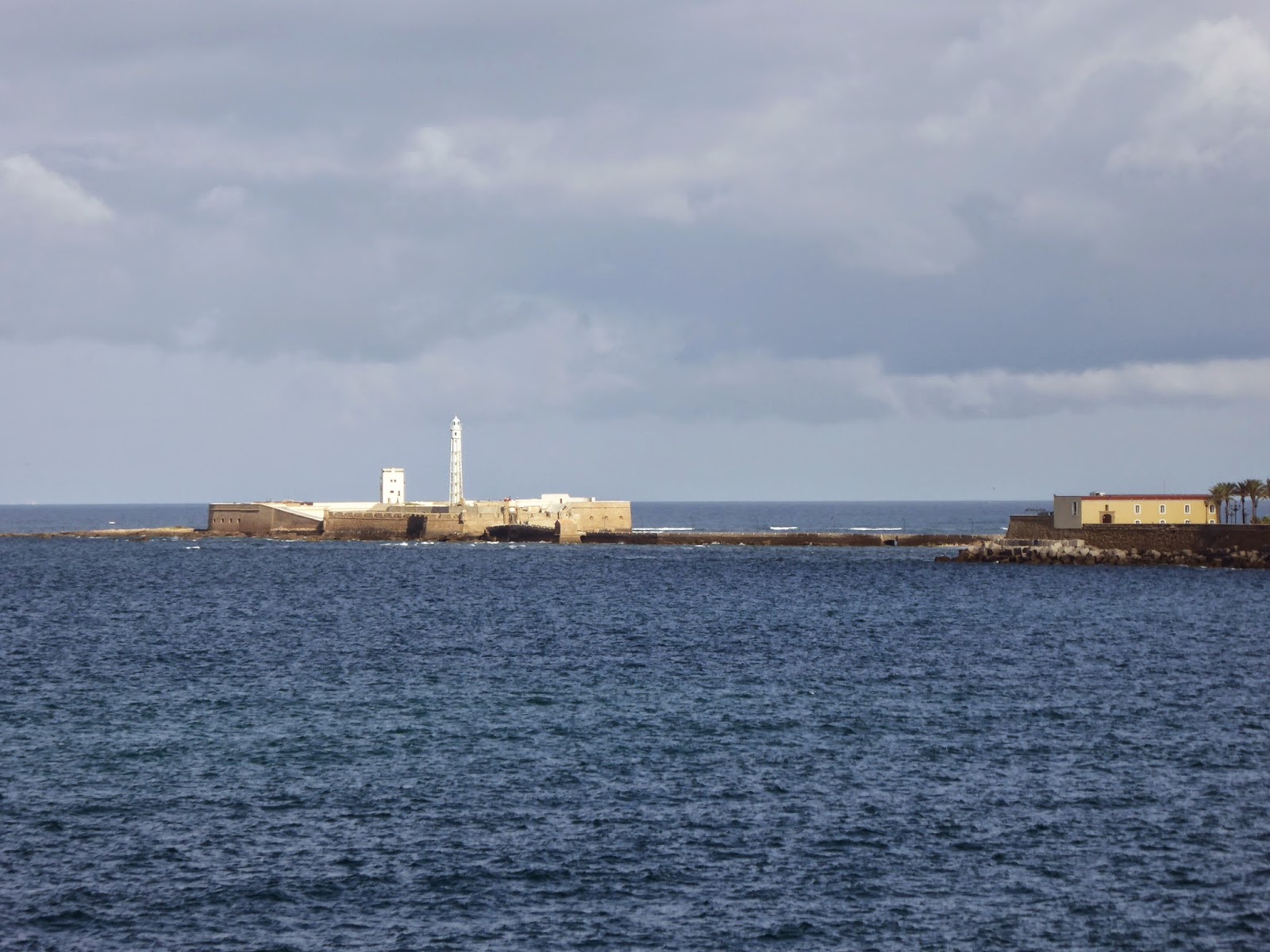
One of the seaward forts. 

We did visit the Central Market – well worth a visit, and lots of fast food places, with a glass of sherry at one euro – and the cathedral, which was rebuilt after Essex destroyed the old one. It took hundreds of years to get it finished. The general style is baroque, and it’s quite OK as Spanish churches go. There’s more daylight than usual. Also, Manuel de Falla is buried in the crypt.


Near the cathedral are plaques in memory of the commander of the Spanish fleet at Trafalgar, who was wounded and died at that house, and then in memory of all the other sailors and soldiers who died at Trafalgar. There is another link with the Peninsular War. Cadiz was the capital of the free Spanish government. A cortes was called which agreed a democratic constitution. Unfortunately when the Spanish King was safely back on his throne, he repudiated it. Still, Cadiz is very proud of its part.

Then off to Estepona. We drove past Medina Sidonia, as in Duke of, commander of the Armada. It’s only occurred to me on this holiday that the “medina” bit is Arab, and the “Sidonia” bit is from the Phoenician’s Sidon.


Actually the hotel is quite a long way outside Estepona. Phil was rather worried about it, as hotels on the Costa del Sol have a reputation. As we got towards the coast the degree of urbanisation – horrible housing developments, waste land, etc, got us worried. But it’s really nice – there are gardens down to the beach and the sea, and the buffet dinner was very good. I’ve already had a swim in the sea.
View from our room.